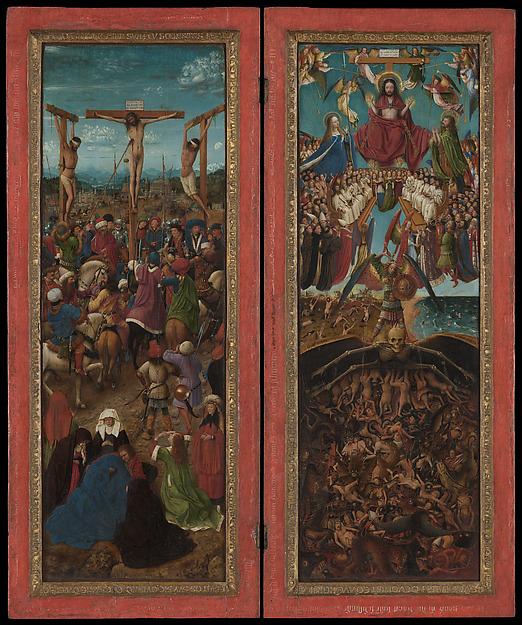
Image title: The Crucifixion; The Last Judgment
Medium: Oil on canvas, transferred from wood
Date: ca. 1436–38
Source:
The Met Collection
“
There never was a good knife made of bad steel.
”
— Benjamin Franklin
Cold Steel & Soft Flesh: The Feminine Body in Soviet Monumental Sculpture
Introduction: Forging Strength from Grace
In the icy forge of Stalinist aesthetics, the female body emerged not merely as an object of beauty or maternal virtue, but as a battleground of paradoxes: soft yet unbreakable, nurturing yet militant, laborious and ethereal. Monumental sculpture in the USSR during the Stalin era (circa 1924–1953) transformed the feminine figure into a symbol of ideological purity, national strength, and the enduring power of Soviet collectivism. These statues were not passive art objects but strategic instruments of propaganda, meticulously engineered to project power, inspire loyalty, and mold societal ideals. This blog delves into the evolution of Soviet monumental sculpture, focusing on the role of the female form in shaping and reflecting the ideals of the time.
Chapter 1: Roots in Revolution – Women as Vanguard Icons (1917–1924)
The Bolshevik Revolution upended traditional roles, and early Soviet art briefly flirted with the idea of the liberated ‘new woman.’ Avant-garde movements like Constructivism and Futurism influenced depictions of the female figure as mechanical, abstracted, and androgynous—an egalitarian ideal reflecting the promise of gender equality. Artists like Vera Mukhina began their careers under these experimental aesthetics, modeling the female form not as traditional divinity or muse but as an embodiment of industrial progress. These early depictions prioritized geometry over flesh and symbolized the erasure of bourgeois femininity in favor of practical, proletarian functionality.
Chapter 2: Enter Socialist Realism – Canonizing the Heroine (1932–Early 1940s)
The imposition of Socialist Realism in 1932 signaled a sharp turn from abstraction to ideological clarity. Art became a vehicle for state propaganda, and the female figure was sculpted with renewed solidity and purpose. Women were now depicted as farm workers, textile laborers, nurses, and partisans—heroic and robust, yet always in service to the collective dream. The works of Mukhina reached their ideological zenith in 1937 with Worker and Kolkhoz Woman, a 24.5-meter stainless steel sculpture combining masculine vigor with feminine poise. Clutching a sickle and hammer, the female figure in the piece gazes fiercely forward, her windswept robes carved with the dynamism of a revolutionary tide. This pairing of gendered bodies—equally matched, forward-seeking—came to encapsulate the egalitarian, if heavily mythologized, gender ideals of Stalinist propaganda.
Chapter 3: Sculpting Motherland – Embodiment of Nationhood (1945–1953)
After World War II, the feminine form in monumental art transformed once again. With the Great Patriotic War still echoing in national memory, monuments to the female body took on the role of embodied grief, sacrifice, and hardened love for the homeland. The Soviet mother became a sacred symbol—part martyr, part warrior. This reached its apotheosis in the 1950s, with designs like the Motherland Calls (eventually erected in 1967, conceptualized during the Stalinist era), a towering sculpture in Volgograd depicting a sword-brandishing matron vociferously summoning her sons to arms. Technologically advanced for the time, it used pre-stressed concrete and internal tension cables to achieve its dynamic, gravity-defying pose—an engineering feat paralleling the ideological weight it carried. Here, the softness of feminine nudity is replaced by the cold austerity of stone and steel, both physically and politically.
Chapter 4: Technology, Gender, and Industrial Poetics
Industrial materials played a critical role in reshaping the visual representation of femininity. Bronze, concrete, and stainless steel replaced marble and clay, imbuing sculptures with a mechanical permanence. This materiality served a dual purpose—it evoked the technological superiority of the Soviet state while metaphorically aligning the female body with the machinery of national production and defense. Philosophically, the female statues of the Stalin era represent an estrangement from organic femininity. They are not mothers purely by biology but by ideological function—their curves chiseled to align with tractor belts, power lines, and the forward thrust of missiles. The artistic triumph was the complete sublimation of sexual desire into civic desire, where beauty became functional, even weaponized.
Chapter 5: Legacy and Resonance in Post-Soviet Memory
Soviet monumental sculptures of women remain scattered across Eastern Europe and Eurasia—immense, austere, and often enigmatic. While the ideological fervor that inspired them has faded, these statues still resonate. For some, they represent cultural resilience, pride, or the hard-earned grandeur of an industrialized nation forcibly modernized. For others, they are eerie relics of propagandistic manipulation and aesthetic monoliths to lost utopias. Today, artists and theorists reevaluate these works through feminist and decolonial lenses, questioning the tension between empowerment and control embedded in their forms. Are these women symbols of state-sanctioned strength or silent bodies molded for ideological compliance? The question remains open—but the sculptures endure, their paradoxes intact.
Conclusion: Stone Flesh, Steel Dreams
In Soviet monumental sculpture, the female body was never just a subject—it was a potent ideological conduit. At once muscular, maternal, militant, and mute, she bore the ambitions of a nation on her chiseled frame. Through the manipulation of form, material, and myth, sculptors under Stalin crafted a vision of womanhood that both empowered and objectified, celebrated and constrained. These massive figures are not merely artifacts of a bygone regime—they are mirrors reflecting the contradictions and complexities of state, gender, and the performative nature of power itself.

Image description:
Details of sculptures at the Soviet Military Cemetery in Warsaw.
License:
CC BY-SA 4.0
Source:
Wikimedia Commons
Useful links: