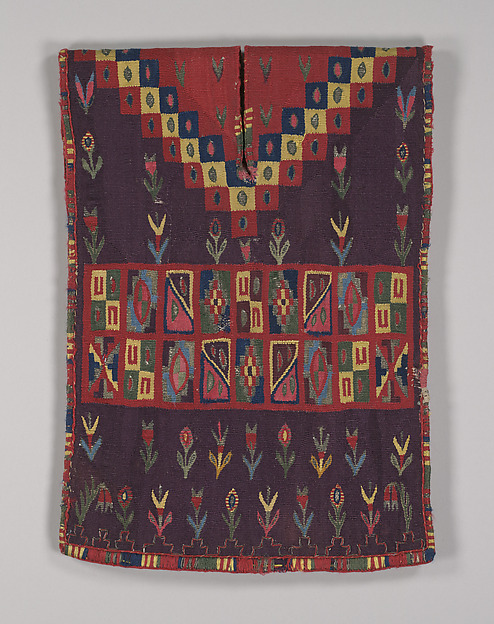
Image title: Miniature tabard
Medium: Cotton, camelid hair, silk, metal
Date: 1600–1700
Source:
The Met Collection
“
The art challenges the technology, and the technology inspires the art.
”
— John Lasseter
Coded Stitches: Textile Art as Data Visualization in Indigenous Cultures
Introduction: Threads That Speak
In the global history of art, textile traditions have often been overlooked when compared with painting or sculpture. Yet, in many Indigenous cultures across the Andes and Pacific Islands, weaving has long served as a sophisticated form of data visualization. Each thread carries meaning—encoded through color, texture, and pattern—to record genealogies, track ecological changes, or map celestial events. These woven codes, much like early computational languages, form a dialogue between human memory, environment, and artistic imagination.
Chapter 1: The Ancient Andes and the Language of Threads
Long before quipus—those knotted strings used by the Inca—Andean textiles served as mnemonic devices, holding together vast networks of ecological and social knowledge. Weavers from pre-Inca civilizations such as the Paracas and Nazca cultures designed complex patterns that referenced agricultural cycles, topographies, and spiritual cosmologies. The chromatic variations in these works were not purely aesthetic but communicative: certain hues corresponded to particular crops, altitudes, or seasons. These codified patterns reflected harmony with the Andean worldview, where mountains, rivers, and stars were intelligible through fabric as much as through ritual.
Chapter 2: Island Looms and the Celestial Ocean
Across the Pacific, weaving also became a medium of navigation and knowledge preservation. In Polynesia and Micronesia, artisans crafted intricate mats and textiles that mirrored spatial awareness essential for life on the sea. These patterns functioned as abstract cartographies—rendering the ocean’s swells, prevailing winds, and migratory bird routes visible on cloth. The elaborate pandanus and barkcloth weavings of Tonga, Samoa, and Hawai‘i reflected ancestral ties and ecological rhythms, transforming data about weather and lineage into beautifully abstracted visual languages. Weavers thus served as both artists and librarians of maritime knowledge.
Chapter 3: Colonial Encounters and the Unraveling of Codes
European colonization disrupted these textile traditions in profound ways. Colonial powers often dismissed Indigenous art forms as decorative handicrafts, suppressing their epistemological importance. Missionary education discouraged symbolic pattern-making, and imported textiles flooded local markets. Yet, many Indigenous weavers preserved their symbolic systems in subtle ways—embedding older patterns within colonial formats or hiding sacred motifs beneath new designs. These acts of creative resistance maintained cultural memory, ensuring that ecology, genealogy, and astronomy remained woven into the very structure of cloth, even under duress.
Chapter 4: The Weaving Renaissance and Modern Interpretation
From the mid-twentieth century onward, Indigenous artisans and scholars began reclaiming textile traditions as repositories of knowledge rather than mere crafts. In Peru, contemporary Quechua weavers reintroduced symbolic motifs once banned or forgotten, linking communities to ancestral ecological data crucial in times of climate crisis. Similarly, across the Pacific, artists are now integrating traditional symbols with modern materials and digital technologies. Some projects translate ancient weaving codes into binary data, highlighting uncanny parallels between Indigenous pattern logic and computer programming—each a structured language of visual and informational order.
Chapter 5: Threads of the Future — Technology and Ancestral Intelligence
Today’s intersection of digital visualization and traditional weaving opens new ethical and philosophical horizons. When software interprets traditional textile patterns as data maps, it bridges Indigenous epistemologies and global technology. Yet this convergence raises critical questions of authorship and cultural ownership: Who controls the translation of living traditions into digital archives? Many Indigenous creators now harness new media to ensure their pattern languages remain dynamic, community-based, and self-determined. Thus, textile art continues to evolve—no longer seen as a static artifact, but as a living algorithm woven with ecological care, ancestral wisdom, and artistic intuition.
Conclusion: The Fabric of Knowledge
Textile art in the Andes and Pacific Islands is more than beauty—it is knowledge embodied. Each loom functions like a database; each motif a sentence; each warp and weft a conversation across time. These coded stitches remind us that data need not be digital to be profound, nor language written to be intelligible. The woven cosmos of Indigenous tradition stands as a testament to humanity’s oldest and most enduring form of information design: art as encoded life.
Useful links: