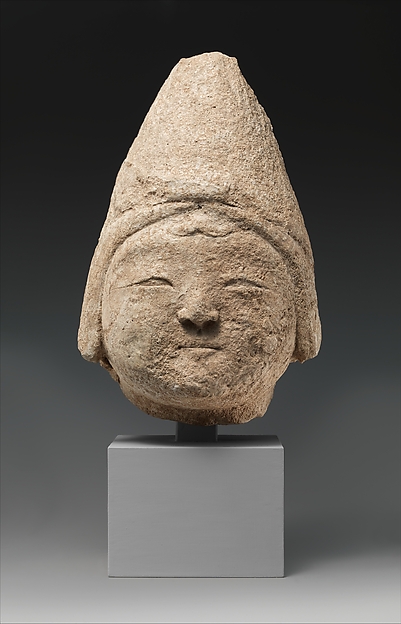
Image title: Head of a Central Asian Figure in a Pointed Cap
Medium: Gypsum plaster; modeled, carved
Date: 12th–early 13th century
Source:
The Met Collection
“
Music in the soul can be heard by the universe.
”
— Laozi
Chiseling the Cosmos: How Ancient Asian Sculptors Interpreted the Universe
Introduction: Sculpting the Sacred
Across the vast sweep of East and South Asian history, sculpture emerged as a medium not just of aesthetic expression but of cosmic mapping. Carved into stone or cast in bronze, ancient Asian sculptures conveyed elaborate visions of the universe—its celestial architecture, spiritual hierarchies, and the cycles of time. Artists were not merely artisans but cosmologists, visualizing metaphysical truths through physical forms. This exploration journeys through the shifting contours of Asian cosmological sculpture, spanning dynasties, doctrines, and artworks that interpreted the universe in matter.
1. The Cosmic Mandala in Early Indian Sculpture
In the Indian subcontinent, from as early as the Maurya and Gupta periods (3rd century BCE to 6th century CE), sculptures portrayed cosmological systems rooted in Hindu, Buddhist, and Jain philosophies. The most iconic representation of cosmic structure is the mandala—a geometrically unified diagram signifying the universe. Although mandalas are more commonly found in painting, their principles deeply informed temple architecture and sculpture. Temples like those in Khajuraho or Ellora are complex, three-dimensional mandalas, with deities placed according to precise cosmological principles. These sculptures are not decorative; they are microcosms, designed to align with the macrocosm of the universe.
Buddhist stupas such as Sanchi (1st century BCE) also embody the mapping of cosmic ideas: the dome symbolizes the world mountain (Mount Meru), circumambulation echoes the paths of celestial bodies, and reliefs illustrate the Buddha’s cosmic role in samsara, the cycle of rebirth. Sculptors thus became key interpreters of philosophical systems, grounding the ineffable in sandstone and stucco.
2. China’s Daoist Heavens and Confucian Order
In ancient China, particularly during the Han dynasty (206 BCE–220 CE), sculpture became a means of articulating both religious transcendence and terrestrial harmony. Daoist beliefs in multiple heavens and immortality manifested in tomb sculptures and reliefs. Stone carvings depict celestial travelers on dragons or phoenixes heading toward the “Isles of the Immortals,” conveying a vertical cosmos of ascent from the mortal realm to heavenly spheres.
At the same time, Confucian ideals of order and hierarchy grounded this cosmic vision in the terrestrial world. Elaborate stone funerary art, including spirit roads flanked by guardian beasts and human officials, modeled the imperial bureaucracy of the afterlife. Sculptors mediated between this world and the next, crafting — in visual code — a mirror of universal rationality and moral structure.
3. Buddhist Cosmic Imagery along the Silk Road
As Buddhism traveled across the Silk Road—through Central Asia into China, Korea, and Japan—it carried with it potent cosmological imagery. A prime example is the rock-cut cave temples of Dunhuang and Longmen (5th–8th centuries CE), where thousands of Buddha figures embody the Mahayana philosophy of infinite Buddhas inhabiting infinite realms. Here, stone walls become visual scriptures: cosmic mountains rise, lotus thrones float, and bodhisattvas multiply, each symbolizing a dimension of cosmic enlightenment.
Noteworthy too are the Vairocana Buddhas—particularly the colossal one at Longmen—who represent the cosmic or universal Buddha, transcending time and space. These immense figures merge iconography with engineering, using scale and symmetry to evoke the ungraspable vastness of the Dharma realm. The sculptor’s vision extended beyond religion into metaphysics: the statue becomes a stabilizing axis mundi in a universe of flux.
4. Japan’s Esoteric Visions in Wood and Bronze
In Japan, particularly during the Heian period (794–1185), esoteric Buddhist schools like Shingon adopted sculpture to articulate the complexities of mandalic cosmology. The famed Mandala of the Two Worlds—Diamond and Womb—found three-dimensional expression in temple halls such as Kōkai’s Tō-ji in Kyoto. Sculptures of wrathful guardians (Myō-ō) and serene Buddhas were arranged in cosmic configurations meant to aid visualization and meditative absorption.
These sculptures often employed advanced casting techniques in bronze, as well as elaborate polychrome wood carving. Each element—from facial expression to gesture (mudra) and position—held cosmological significance. The artistic practice shifted toward the participatory: the viewer was not outside the universe but a practiced meditator within it, engaging with each sacred form as a spiritual map.
5. Southeast Asia: Mount Meru and the Temple as Universe
South in Southeast Asia, particularly Cambodia and Java, Hindu and Buddhist cosmological concepts merged into sculptural masterpieces at temples like Angkor Wat and Borobudur (9th–12th centuries). Angkor Wat’s central tower symbolizes Mount Meru, while its concentric galleries mimic the oceans and continents of the Hindu-Buddhist universe. Sculptures here range from celestial dancers (apsaras) to divine warfare scenes—each panel carved as a chrono-mythological story across time and space.
Borobudur, a massive Buddhist mandala in stone, culminates in a dome surrounded by openwork stupas housing Buddha statues facing the cardinal directions. Ascending its terraces mirrors spiritual ascent through realms of existence. The sculptor here acted as both metaphysician and engineer, building not an image of the universe, but an immersive cosmic experience.
Conclusion: Materializing the Infinite
In the ancient Asian imagination, sculpture was not merely form—it was philosophy crystalized in metal and stone. Across regions and centuries, sculptors served as cosmographers, recording spiritual, temporal, and spatial knowledge into enduring visual codes. These artworks continue to inspire awe not only for their craftsmanship but for the universes they reveal—silent yet eloquent messages from civilizations that saw no boundary between the sacred and the sculpted, the cosmos and the chisel.

Image description:
The Garden of Cosmic Speculation is a 30 acre (12 hectare) sculpture garden created by landscape architect and theorist Charles Jencks at his home.
License:
CC BY-SA 3.0 rs
Source:
Wikimedia Commons
Useful links: