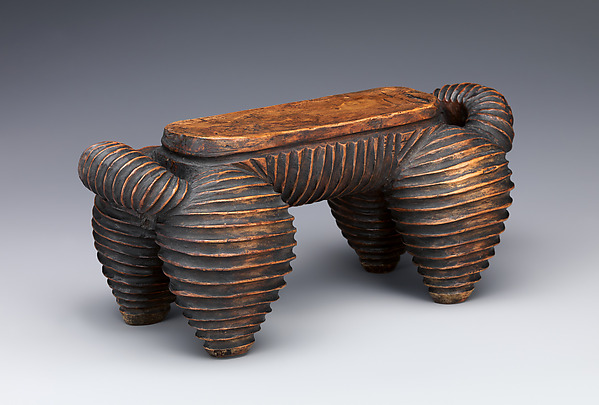
Image title: Zoomorphic headrest
Medium: Wood
Date: Mid–late 19th century
Source:
The Met Collection
“
The personal life deeply lived always expands into truths beyond itself.
”
— Anaïs Nin
Carvings in the Ice: Indigenous Arctic Sculpture Beyond the Tourist Gaze
Introduction: Unveiling Stories in Stone and Bone
In the pristine isolation of the Arctic, where the horizon blurs between ice and sky, a profound artistic tradition has been quietly thriving for centuries. The Inuit and other Indigenous circumpolar peoples have long transformed materials like soapstone, bone, and ivory into sculptures that embody more than aesthetics—they are spiritual vessels, historical documents, and expressions of survival. Too often, these artworks are flattened into souvenirs for tourists, stripped of their cultural gravity. This article reclaims their deeper meanings, tracing the evolution of Arctic sculpture across time and context.
1. Ancestors and Animism: The Origins of Arctic Sculpture
Long before colonial contact, Arctic sculpture was inseparable from spiritual life. Rooted in animist beliefs, these works were not mere decorations but active participants in cultural survival. Carvings made from walrus ivory or whalebone often represented animals like seals, caribou, and polar bears—each imbued with spirit. Shamans, believed to mediate between worlds, would carry small carved figures called tuunraq or inua to invoke guidance or protection. Art was never distant from utility, with many carvings doubling as tools or amulets. This fusion of aesthetics and spirituality through sculpture shaped the early foundations of Indigenous Arctic art.
2. Contact and Consequence: The Colonial Interruption
The 19th and early 20th centuries brought waves of missionaries and traders to the Arctic, introducing Christianity and capitalist trade. These forces fundamentally altered Indigenous life and artistic output. Materially, artists began using steel tools introduced by outsiders, allowing for greater detail and speed in carving. Culturally, many spiritual themes were suppressed or reinterpreted under religious pressure. The Inuit began producing small sculptures for European and North American markets, often depicting scenes of daily life such as hunting or family life—palatable narratives for outsiders. The commodification of Arctic sculpture was born, even as artists quietly preserved ancestral motifs beneath its surface.
3. The Postwar Boom and the Rise of the ‘Arctic Aesthetic’
After World War II, Canadian government programs actively promoted Inuit carving as a viable industry, especially in northern communities like Cape Dorset (Kinngait). Cooperative studios were formed, and many artists found sustainable livelihoods, albeit shaped by market demands. Soapstone became the material of choice, favored for its accessibility and visual appeal. Artists like Osuitok Ipeelee and Pauta Saila gained recognition for their dynamic animal forms, establishing a visual language often seen as quintessentially “Arctic.” Yet beneath these forms were layered cosmologies—spirits, transformations, and mythologies obscured by the labels affixed to them in southern galleries.
4. Changing Voices: Contemporary Interpretations and Resistance
Contemporary Indigenous artists are challenging the limited lens through which Arctic sculpture has been viewed. Emerging voices are reintroducing spirituality, political commentary, and personal narrative into their work. Artists like Michael Massie blend traditional themes with modern irony, while others revisit ancient shamanic forms. Digital tools and global platforms now enable diverse expressions, from large-scale installations to multimedia art. A new generation refuses to be pigeonholed by tourist expectations, instead opening dialogues on identity, climate change, and colonial legacies. These practices reflect a living, adaptive art form rather than a frozen “folk” tradition.
5. Philosophy in Form: Sculpture as Survival and Symbiosis
At its heart, Arctic sculpture is a philosophy of relationship—between people and animals, land and spirit, survival and creativity. The act of carving itself is rooted in deep attentiveness to the material, often repurposing what nature offers: a mammoth tusk unearthed from thawed permafrost, whale vertebrae left after a subsistence hunt. This ecology of materials speaks to a worldview in which nothing is wasted and everything is connected. Indigenous Arctic sculpture teaches us not just about a people or region, but about a whole way of being in the world—personally, communally, and ecologically.
Conclusion: Beyond the Gift Shop
To truly appreciate Indigenous Arctic sculpture is to listen to its silences and see past its surfaces. These carvings are not quaint artifacts or market curios—they are living testaments to cultural resilience, memory, and cosmology. As new generations pick up tools both ancient and digital, their stories continue to be carved—quiet but enduring—into soapstone, spirit, and snow.
Useful links: