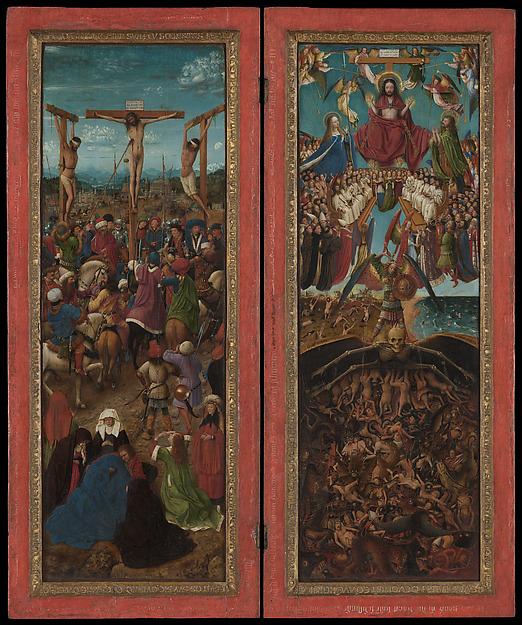
Image title: The Crucifixion; The Last Judgment
Medium: Oil on canvas, transferred from wood
Date: ca. 1436–38
Source:
The Met Collection
“
Once we accept our limits, we go beyond them.
”
— Albert Einstein
Beyond Blue and White: Rediscovering African Ceramic Traditions
1. The Earth Speaks: Origins of African Ceramics
Long before porcelain and fine china were perfected in Asia or Europe, African artisans were transforming clay into both functional and spiritual objects of deep cultural resonance. Across sub-Saharan Africa, pottery has never been separated from the rhythms of daily life. Clay was drawn from riverbanks and sculpted by hand, often without a potter’s wheel, into vessels that told stories of fertility, ancestry, and community. Archaeological discoveries in regions such as Nigeria and Mali reveal ceramic histories that date back thousands of years, with pottery fragments serving as early documents of human creativity. The Nok culture, for example, produced terracotta sculptures as early as 1000 BCE, combining utilitarian and narrative qualities in a single form.
2. Vessels of the Spirit: Symbolism and Sacred Meaning
To understand African ceramics is to appreciate clay as more than a material—it is a spiritual substance. Many societies imbued the pot with life-giving power. Among the Yoruba of Nigeria, pots used in ritual ceremonies were thought to channel the presence of the divine, serving as intermediaries between humans and the gods. In Central and Southern Africa, rituals surrounding birth, marriage, and death each demanded their own forms and decorative languages. Motifs carved or painted on the surface might represent fertility, ancestral lineage, or the cyclical nature of existence. The vessel was both a physical and metaphysical container, holding not only food or water but also memory, protection, and meaning.
3. Innovation in Form: Diversity and Regional Styles
Contrary to Eurocentric narratives that simplify African ceramics as primitive or purely functional, sub-Saharan pottery demonstrates technical mastery and aesthetic sophistication. The variety is staggering. In the Sahel, thin-walled, burnished pots display a refined minimalism; in contrast, the Mangbetu people of the Democratic Republic of Congo created vessels whose elongated, coiffed heads mirror their celebrated sculptural style. East African coastal artisans experimented with vibrant slips and intricate incisions influenced by Indian Ocean trade, while in Southern Africa, the Zulu and Shona developed distinctive geometric designs linked to ancestral iconography. These forms embody philosophies of balance, community, and adaptation—qualities essential to both survival and artistic longevity.
4. Transformations Through Contact and Modernity
Colonial contact reshaped the narrative of African pottery in complex and contradictory ways. European collectors and anthropologists often catalogued African ceramics as ethnographic artifacts rather than art, reinforcing racial hierarchies in global aesthetics. However, exchange also stimulated innovation. Exposure to new materials, glazes, and markets gave rise to hybrid forms that connected tradition and modernity. In the twentieth century, artists such as Magdalene Odundo—though based in the diaspora—redefined ceramics by combining African sensibilities with global techniques, producing forms that challenge the boundaries between craft and fine art. These transformations exemplify resilience—the power of cultural expression to endure and evolve despite colonial disruption.
5. Contemporary Reverberations: Tradition Meets Global Design
Today, African ceramic traditions continue to evolve through a dialogue between heritage and innovation. Contemporary potters across Nigeria, Kenya, and South Africa are reclaiming local techniques while incorporating new technologies such as kiln engineering and glaze chemistry. Projects like the Ardmore Ceramic Studio in South Africa demonstrate how collaboration between artists revitalizes regional craftsmanship in the global art economy. Museums and galleries are also beginning to reassess the place of African ceramics, not as peripheral curiosities but as central expressions of aesthetic philosophy. In an age that values sustainability and authenticity, African pottery offers profound lessons about the relationship between human beings, nature, and creativity. Beyond the muted monochrome of globalized design, these ceramics radiate with color, rhythm, and spirit—an enduring testament to the continent’s artistry and its dialogue with the earth itself.
Useful links: