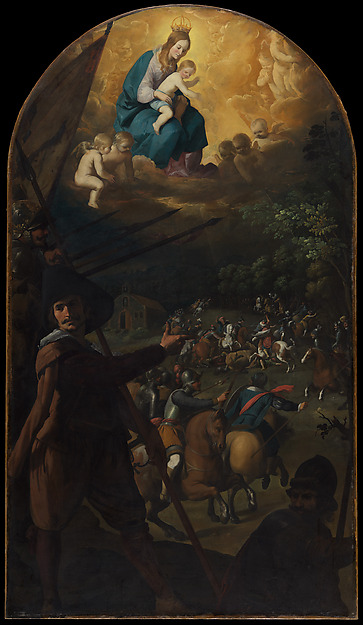
Image title: Battle between Christians and Muslims at El Sotillo
Medium: Oil on canvas
Date: ca. 1637–39
Source:
The Met Collection
“
When deeds and words are in accord, the whole world is transformed.
”
— Zhuang Zhou
Between Canvas and Stage: Painters Who Transformed Theater
Introduction: When the Brush Meets the Footlights
The relationship between visual art and the performing stage has often been one of parallel inspiration, but in certain luminous moments of history, the painter’s imagination has stepped directly into the world of theater. From the sumptuous designs of Léon Bakst’s Ballets Russes to the abstract explorations of David Hockney’s opera sets, painters have used theatrical space as a living canvas: one that breathes, moves, and speaks through light and motion rather than oil and pigment. The result has been a continual redefinition of what it means to ‘paint’ in three dimensions.
Chapter One: The Birth of a Modern Spectacle – Léon Bakst and the Ballets Russes
In the early twentieth century, the Ballets Russes exploded across Europe like a burst of color after a long gray winter. At the center of this revolution stood Léon Bakst, a Russian painter whose designs for Sergei Diaghilev’s productions transformed theatrical costume and scenery into kinetic art. His palette, inspired by Orientalism and Symbolism, turned the stage into a vibrant dream. In productions like *Scheherazade* (1910), Bakst abandoned decorative realism for bold abstraction and sensual color harmonies. The stage became not a backdrop but a living painting in motion, reshaping audience expectations of theater as both visual art and performance.
Bakst’s work had philosophical implications: it suggested that art could transcend static form. In the electric glow of stage lighting, fabric and pigment dissolved into pure emotion. This was the dawn of a new visual modernism—one that extended into fashion, interior design, and later cinema.
Chapter Two: Surrealism Enters the Stage – Dalí, Picasso, and the Freudian Dream
By the 1930s and 1940s, Surrealism and Cubism had already transformed painting, but their collision with theater and dance proved even more radical. Pablo Picasso’s designs for *Parade* (1917) took Cubism’s fractured planes and reassembled them into giant, walking sculptures on stage. Salvador Dalí, meanwhile, approached theater as an entry point into psychological fantasy. His collaborations with choreographers like Leonide Massine and filmmakers like Alfred Hitchcock infused performance with dreamlike distortion and Freudian symbolism. Curtains became subconscious veils, props morphed into archetypes, and dancers embodied states of desire and madness.
This movement reflected a broader cultural shift: the recognition of the theater as a psychological laboratory. Painters who entered the stage design realm were not merely illustrating stories—they were building emotional architectures in real time, anticipating the immersive art installations of the late twentieth and twenty-first centuries.
Chapter Three: Mid-Century Abstraction and the Geometry of Space
Postwar modernism brought a new visual language of abstraction, geometry, and light. Artists influenced by Bauhaus principles—like László Moholy-Nagy—and scenographers working in opera and experimental theater began to think of stage lighting as paint, and space as sculptural form. Josef Svoboda, though primarily a scenographer rather than a painter, embodied this synthesis. His use of projection, moving screens, and optical illusion drew heavily on modern art’s fascination with perception and technology.
In parallel, abstract painters such as Mark Rothko and Barnett Newman inspired stage artists to think of color as environment. Though Rothko never designed a theater production, his immersive canvases deeply influenced lighting designers who saw the stage as a breathing color field. By mid-century, the border between painted and constructed space had truly blurred—paving the way for multimedia experiences that treated light as a tangible substance.
Chapter Four: David Hockney and the Pop Modern Stage
In the later twentieth century, British painter David Hockney brought a painter’s clarity and wit to the opera house. His designs for productions such as *A Rake’s Progress* (1975) and *Tristan und Isolde* (1987) demonstrated how Pop Art sensibilities—flat colors, graphic precision, and ironic self-awareness—could revitalize classical forms. Hockney’s stages were compositions in motion, where scenic planes shifted like pages of a picture book and perspective was deliberately toyed with to mirror the music’s emotional tone.
Hockney also embraced technological innovation early, experimenting with iPad drawings and digital projections in his later stage works. His art for theater extended the Bauhaus idea of total design but layered it with a modern understanding of perception—how we consume images in an age dominated by screens. The painter once again became a magician of illusion, balancing handcraft and technology to form a seamless artistic experience.
Chapter Five: Light, Motion, and the Future of Painterly Theater
Today, the painter’s role in theater has evolved into that of a visual architect or media artist. Digital projection, video mapping, and interactive stage technologies have freed designers from traditional limitations. Artists like Olafur Eliasson, known for immersive light environments, and Es Devlin, merging sculpture with video architecture, continue the lineage that Bakst began a century ago. The stage is once again a canvas—though now rendered in photons and algorithms rather than pigment.
The philosophical essence remains intact: to create spaces that evoke emotion, provoke thought, and dissolve the barrier between illusion and reality. The heritage of painters in theater reminds us that every stage—no matter how technologically advanced—remains a place of transformation, a living canvas where art and life converge in radiant symbiosis.
Conclusion: The Eternal Dialogue Between Sight and Sound
From Bakst’s opulent fantasies to Hockney’s crisp geometries and today’s digital spectacles, painters who ventured into the theater have continually redefined how we see performance. They have reminded audiences that theatrical design is not mere decoration but a visual score composed in concert with music, movement, and narrative. The stage, when touched by a painter’s hand, becomes a shimmering threshold between worlds—a place where perception itself takes center stage.
Useful links: