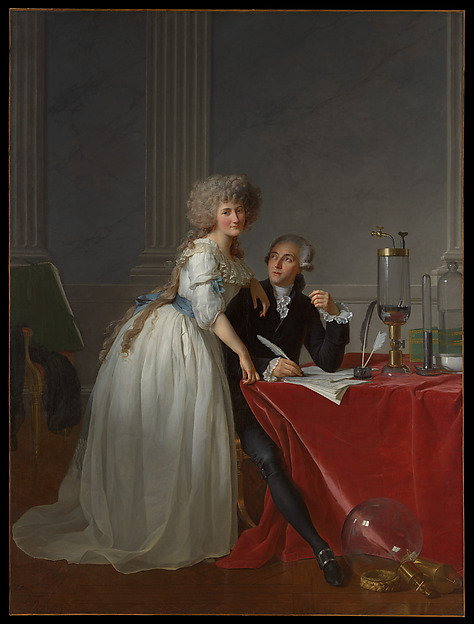
Image title: Antoine Laurent Lavoisier (1743–1794) and Marie Anne Lavoisier (Marie Anne Pierrette Paulze, 1758–1836)
Medium: Oil on canvas
Date: 1788
Source:
The Met Collection
“
Ask yourself the secret of your success. Listen to your answer and practice it.
”
— Richard Bach
Alchemy and Oil: The Secret Science of Renaissance Pigments
Chapter I: The Alchemical Origins of Art
Long before artists were considered masters of technique and vision, they were experimenters in a form of proto-chemistry. The medieval workshop was not merely a place of aesthetic practice but a laboratory where pigments were born from minerals, plants, and even insects. Artists inherited the secrets of alchemists, who sought to transform base substances into gold. In a symbolic sense, painters achieved that very goal: transmuting dull earth into radiant color. Lead became white, copper turned blue, and sulfur yielded ethereal yellows. This merging of mystical inquiry and practical experimentation laid the foundation for what would later become both modern chemistry and the luminous painting of the Renaissance.
In these centuries, the boundaries between science and magic blurred. When an artist ground lapis lazuli into powder to extract ultramarine, he was reenacting an alchemical transmutation—unlocking beauty through transformation. Thus, the story of Renaissance color begins in mystery, with pigment as a ritual substance and color as revelation.
Chapter II: The Renaissance Laboratory
As Europe entered the fifteenth and sixteenth centuries, the artist’s studio transformed into an atelier equipped with mortars, pestles, crucibles, and glass vessels. Figures like Leonardo da Vinci and Cennino Cennini recorded recipes for pigments alongside anatomical sketches and theories of light. Oil painting itself—supplanted over tempera—allowed pigments to be suspended in a medium that both preserved and magnified their brilliance. This revolution, initiated by Northern European masters like Jan van Eyck, enabled subtler gradients, smoother transitions, and greater durability. It was not just a change of technique but a leap forward in material science.
Oil offered translucency, flexibility, and depth. When mixed with linseed or walnut oil, minerals behaved differently, capturing light rather than merely reflecting it. Painters discovered by experimentation what modern physics later described: that light interacts with layered substances to create vibrancy and spatial illusion. In the silent glow of drying oil, chemistry was at work—matter reorganizing into beauty.
Chapter III: Vermeer and the Optics of Light
Few artists exemplify the fusion of art and science more than Johannes Vermeer. In seventeenth-century Delft, a city alive with trade and technical innovation, Vermeer turned to materials imported from distant lands to compose his tranquil interiors. Scholars have often noted his probable use of a camera obscura—a device harnessing the physics of light projection—to study the behavior of illumination within space. Equally fascinating is his use of rare pigments: natural ultramarine from Afghan lapis, lead-tin yellow, and the subtle greens born from mixing earth-based colors with oil mediums. Each pigment was a chemical marvel, costly and volatile, yet essential to his signature luminosity.
Vermeer’s work, at its core, is about transformation: how simple materials—lead, sand, minerals, and oil—can capture the essence of human quietude and the radiance of light itself. His canvases were surfaces where the unseen interplay of chemistry produced what philosophers might call the materialization of spirit.
Chapter IV: Titian, Venice, and the Birth of Color as Emotion
In Venice, the art of coloring reached its sensual peak under Titian. The lagoon city was a hub of global trade, where pigments from the East met European innovation. Titian exploited this abundance, using oil not just as a binder but as an expressive medium in its own right. His approach was almost geological: building layers of glazes that breathed light into flesh, fabric, and sky. The red lakes he used—made from cochineal or madder—would deepen over time, reacting with oils to create living tones that shifted subtly with changing light.
Venetian painters, inspired by both commerce and curiosity, became the alchemists of color. Their mastery foretold the romantic ideal that color could express human emotion directly. The very act of painting became an experiment in transformation—a precursor to the modern artist as both scientist and philosopher.
Chapter V: The Legacy – From Secret Recipes to Modern Science
The Renaissance pigment recipes that once filled dusty notebooks gradually gave way to the laboratory and the factory. The Industrial Revolution transformed pigment production from craft to science: synthetic ultramarine, cadmium yellow, and Prussian blue replaced their rare and costly predecessors. Yet the spirit of Renaissance experimentation lived on in this transition. The scientific study of light, optics, and color theory owes much to the trials, errors, and triumphs of early painters who tested the boundaries of oil, minerals, and time.
Today, materials science still traces its lineage to those Renaissance artisans who blended mysticism with measurement. When museums analyze the chemistry of a Titian glaze or the refractive properties of Vermeer’s blue, they reveal the enduring dialogue between art and science. Each layer of oil and pigment is a record of human curiosity—alchemy refined into artistry, and artistry transformed into knowledge.
Useful links: