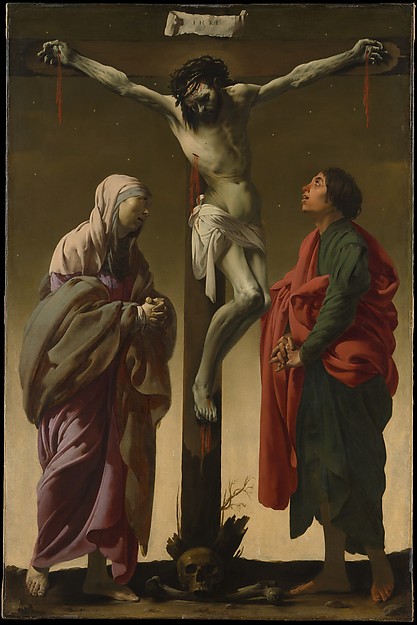
Image title: The Crucifixion with the Virgin and Saint John
Medium: Oil on canvas
Date: ca. 1624–25
Source:
The Met Collection
“
When watching after yourself, you watch after others. When watching after others, you watch after yourself.
”
— The Buddha
After the Fall: Reimagining Classical Sculpture Through Postcolonial Eyes
Introduction: Marble Myths and Modern Reckonings
For centuries, Greco-Roman sculpture has represented the pinnacle of ideal beauty in Western art. Chiseled marble bodies, serene faces, and mythic narratives became shorthand not only for aesthetic perfection but also for cultural superiority. These statues adorned museums, academic texts, and imperial plazas—projecting an image of the West as inheritor of a noble classical past. But as the colonial scaffolding that upheld this image has been dismantled, artists from historically marginalized cultures are looking anew at these marble gods—not with reverence, but with rigor. This blog explores how contemporary artists reinterpret classical sculpture through a postcolonial lens, unraveling embedded ideologies and reasserting alternate histories across five transformative chapters of artistic engagement.
1. Antiquity Reclaimed: The Classical Canon and the Imperial Gaze
The Neoclassical revival of the 18th and 19th centuries enshrined Greco-Roman statuary as the gold standard of beauty and civilization. During Europe’s imperial expansion, classical sculpture became a visual language that imperial powers used to validate their dominance. The display of looted antiquities—from the Elgin Marbles in the British Museum to Roman busts in French salons—was not a neutral act of admiration but a political maneuver reinforcing colonial hierarchies. The muscular, often white-washed bodies of marble became metaphors for rationality, control, and Western masculinity.
Yet, these sculptures were often stripped of their original context. Their vibrant histories—literally, as many were once painted—were buried beneath veneers of purity. What remained was a selective memory, one that contemporary postcolonial artists have begun to question and unravel.
2. Shattered Whiteness: Deconstructing the Myth of Purity
In recent decades, artists and scholars have challenged the presumed whiteness in classical art. Historical evidence—including pigment analysis—has revealed that many ancient sculptures were originally painted in vivid colors. Yet, the idea of unpainted, white marble prevailed, correlating ironically with racialized notions of Western superiority. Postcolonial artists like Kenyan-born British artist Yinka Shonibare subvert this myth by restaging classical scenes with Black bodies and African textiles. His works question how Western ideals have been shaped by aesthetic choices that erase cultural complexity.
Similarly, US-based sculptor Sanford Biggers fuses African and Greco-Roman motifs in startling juxtapositions. His sculptures aren’t just hybrids—they’re critiques of cultural theft and displacement. By ‘polluting’ the purity of white marble with other materials, colors, and narratives, these artists challenge the inviolability of the classical ideal.
3. Bodies in Ruin: Fragmentation as Resistance
Many contemporary artists engage with classical sculpture not by replicating its former glory, but by emphasizing its brokenness. This is not an accident. The fragment becomes a metaphor—of lost histories, of interrupted narratives, of colonized bodies. British artist Cassils, a performance artist whose work plays with body transformation and power, references classical torsos but destabilizes their gendered and racial expectations. Their sculptures and performances probe queerness as a rupture within dominant visual traditions.
The strategy of fragmentation is also used by Nigerian artist Ndidi Dike, who dismembers Western symbols and integrates them with African cultural symbols. Her work suggests that it is only in shattering the classical ideal that new, inclusive forms of identity and memory can emerge.
4. Digital Ruins: Technology as Postcolonial Tool
In an era of 3D scans, digital modeling, and augmented reality, technology has become a powerful ally in reimagining classical sculpture. Institutions like the Met and the British Museum have digitized collections—but contemporary postcolonial artists are flipping the narrative. Italian-Egyptian visual artist Morehshin Allahyari’s project “Material Speculation” uses 3D printing to reconstruct destroyed cultural artifacts from the Middle East. Her work contextualizes each piece with historical narratives and digital data, reclaiming heritage through tech.
By remapping who gets to preserve, edit, or access the past, these digital interventions become acts of political resistance. They mark a shift from viewing classical heritage as immutable stone to pliable code—open to reinterpretation, remix, and critique in a networked world.
5. Toward a New Pantheon: Reclaiming the Canon
The reimagining of classical sculpture through postcolonial critique is more than a rejection—it is a reclamation. By disrupting the static, glorified image of the classical body, artists are proposing new pantheons where marginalized identities can coexist, contradict, and converse with past traditions. This process is not about erasing history but re-authoring it with voices long suppressed.
From street installations in Johannesburg that mimic Greco-Roman statuary in modern African dress, to Caribbean artists like Ebony G. Patterson integrating classical motifs with fabric, glitter, and floral decay, a global movement is at hand. These works don’t merely respond to the West—they destabilize its grip on art history, making space for global histories to be seen, heard, and made permanent not in stone, but in spirit.
Conclusion: After the Fall
The fall signaled by the title is not a collapse of beauty or integrity, but a letting go of singular narratives. Postcolonial reinterpretations of classical sculpture challenge us to reconsider what has been upheld as timeless, and by whose authority. As new sculptures rise from the fragmentation—diverse in form, intent, and origin—they signal a future where art is not a monologue but a conversation, sculpted not in dominance, but in dialogue.

Image description:
View from below of Dynamic Mobile Steel Sculpture, an abstract sculpture from 1979 by Canadian artist George Norris (1928-2013). The statue is located in a foyer of the Central Branch of the Great Victoria Public Library (between Broughton and Courtney St), Victoria, British Columbia, Canada
License:
CC BY-SA 4.0
Source:
Wikimedia Commons
Useful links: