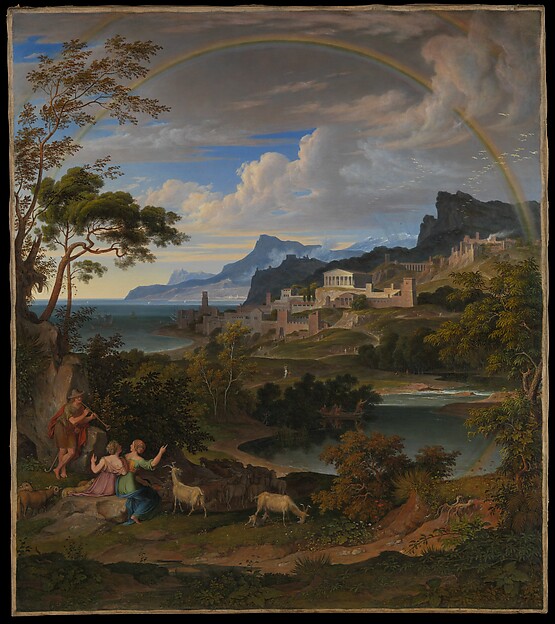
Image title: Heroic Landscape with Rainbow
Medium: Oil on canvas
Date: 1824
Source:
The Met Collection
“
When watching after yourself, you watch after others. When watching after others, you watch after yourself.
”
— The Buddha
After Eden: Eco-Criticism in Contemporary Landscape Painting
Introduction – The Green Mirror Refracted
From the earliest cave paintings to the sweeping vistas of Romanticism, the landscape has served as a canvas for humanity’s shifting relationship with nature. In today’s age of climate crisis and ecological uncertainty, contemporary landscape painters revisit this age-old genre with new urgency. Blending aesthetic tradition with environmental consciousness, these artists create a visual language of alarm, mourning, activism, and hope. This blog explores how landscape painting has evolved into a potent form of eco-criticism, particularly in the 21st century, by tracing its historical roots, cultural shifts, and technological influences.
1. Arcadias Lost: The Legacy of Pastoral Painting
To understand the foundations of environmental critique in landscape painting, we must begin with the pastoral tradition. Originating in ancient poetry but flourishing in visual form during the Renaissance and Baroque periods, pastoral scenes often idealized nature as a harmonious, ordered space—what one might call a ‘Garden of Eden.’ Artists like Claude Lorrain and Nicolas Poussin painted Arcadian landscapes that celebrated human coexistence with a tamed, sublime environment. But even then, these works contained ideological tensions: they were visions of man in dominion over nature, not in dialogue with it. As Enlightenment rationalism and Romanticism emerged, the landscape began to reflect interior emotional states and sublime awe, seen in the brooding mountains of Caspar David Friedrich or the tempestuous seas of J.M.W. Turner. This shift laid the groundwork for artists to engage with nature not as a passive backdrop, but as an active presence and, increasingly, a victim of human encroachment.
2. Industrial Smoke and Modern Skies
The Industrial Revolution marked a turning point in landscape painting’s trajectory. As factories mushroomed and skylines darkened with soot, artists began to question the cost of progress. In the 19th century, the Barbizon School in France—painters like Jean-François Millet and Théodore Rousseau—began documenting rural labor and the erosion of traditional life. Meanwhile, the Impressionists, though celebrated for their luminous brushstrokes, subtly hinted at modernity’s effects, with train stations and urban encroachment often appearing in their works. The American Hudson River School, initially celebratory of frontier expansion, also evolved into a lament for vanishing wilderness. By the turn of the 20th century, art no longer shied away from depicting pollution, deforestation, and the alienation from land wrought by industrialization—setting the stage for the rise of eco-critical art.
3. Postmodern Landscapes and Environmental Consciousness
Post-World War II art saw the rise of abstraction, conceptual art, and land art—all of which redefined the landscape. Artists like Robert Smithson and Nancy Holt used natural materials to create site-specific works that questioned the boundaries between art and environment. Smithson’s “Spiral Jetty,” constructed from rock and salt in Utah’s Great Salt Lake, is both a monumental sculpture and a decaying symbol of entropy—a precedent for artists confronting the planetary consequences of human intervention. Parallel to these interventions, photographers such as Edward Burtynsky began documenting industrial scars on the Earth: quarries, oil fields, and toxic waste sites. These visual records, while not romantic landscapes, exposed how deeply human activity had terraformed nature. Such works transitioned the landscape genre from idyllic representation to forensic analysis, expanding its critical capacity.
4. Digital Landscapes: Technology and the Anthropocene
Entering the new millennium, the term “Anthropocene”—denoting humanity’s geological impact—began to permeate scientific, philosophical, and artistic discourse. Contemporary landscape painters have not only embraced this concept but adapted their methods to new technological realities. Some integrate satellite imagery, GIS data, and drone perspectives, creating composite vistas that visualize ecological collapse on both macro and micro scales. Artists like Alexis Rockman merge naturalistic detail with dystopian imagination, rendering mutant ecosystems and bioengineered wildlife that comment on climate disruption. Others, like Marina Zurkow, generate participatory digital works that simulate environmental feedback loops. These artists straddle the analog and digital, the visible and the invisible, aiming to evoke a visceral understanding of the planetary systems unraveling around us.
5. Painting the Climate Crisis: Contemporary Eco-Aesthetics
In the 21st century, numerous artists use the canvas as a site of activism and environmental reflection. Painters like Diane Burko document melting glaciers with scientific precision and painterly emotion. Her large-scale works juxtapose abstract color fields with geographic references, conveying both beauty and despair. Likewise, artists such as Hannah Brown and John Sabraw explore themes of biodiversity loss and toxic landscapes, blending sensitive brushwork with sustainable materials. In parallel, Indigenous artists bring spiritual and ancestral perspectives to the landscape, highlighting its role as both a habitat and a relative. These practices not only critique environmental devastation but also offer reinterpretations of survival, resilience, and ecological interconnectedness. As the planet continues heating, flooding, and burning, such paintings carry the dual weight of witness and warning.
Conclusion – Art as Environmental Witness
Today’s eco-conscious landscape painting stands at a convergence of tradition and transformation. By drawing on centuries-old visual languages while adapting to ecological and technological realities, contemporary artists continue to redefine what landscapes mean—and why they matter. In this post-Eden world, where paradise is no longer lost but imperiled, art becomes a form of ecological testimony. It beckons us not just to observe nature, but to reckon with our role within it. Now more than ever, the landscape is not just a place of beauty—it is a call to action.

Image description:
By virtue of Agoo Municipal Ordinance No. 04-2014 designating the Alluvium in Santa Rita West and Central, Agoo, La Union as Eco-Tourism Park known as Agoo Eco-Fun World of the Agoo-Damortis Protected Landscape and Seascape (Santa Rita Sur, West and Central, Agoo, La Union) Agoo–Damortis Protected Landscape and Seascape is located on the eastern side of Lingayen Gulf Panoramics of the Agoo–Damortis Protected Landscape and Seascape (Santa Rita Sur, West and Central, Agoo, La Union) Santa Rita (Agoo) Fish Farm The Sustainable Coral Reef Ecomanagement System Program DENR-PAMB Office, Agoo Santa Rita Central, Agoo, La Union Tsunami Hazard Zone MacArthur Highway (Agoo, La Union) Category:Sitios and puroks of the Philippines Subdivisions of the Philippines List of barangays in La Union Barangays Santa Rita Norte 16.3547, 120.3540 Santa Rita East 16.3508, 120.3544 Santa Rita Sur 16.3425, 120.3489 Santa Rita Central 16.3519, 120.3469 Santa Rita West 16.3487, 120.3480 Agoo, La Union from or along Aspiras–Palispis Highway or Marcos Highway from along or from MacArthur Highway (Santo Tomas, La Union section) of the MacArthur Highway or Manila North Road) Philippine highway network (Note: Judge Florentino Floro, the owner, to repeat, Donor Florentino Floro of all these photos hereby donate gratuitously, freely and unconditionally Judge Floro all these photos to and for Wikimedia Commons, exclusively, for public use of the public domain, and again without any condition whatsoever).
License:
CC0
Source:
Wikimedia Commons
Useful links: