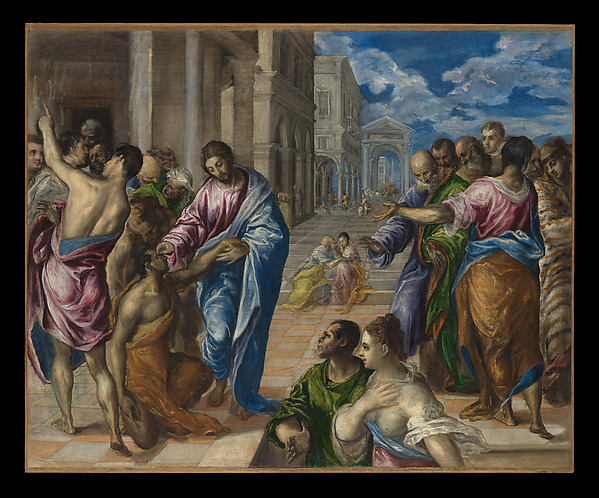
Image title: Christ Healing the Blind
Medium: Oil on canvas
Date: ca. 1570
Source:
The Met Collection
“
Love is blind; friendship closes its eyes.
”
— Friedrich Nietzsche
‘Eyes Like Ours’: Self-Portraits by Blind Artists Through Tactile Media
Introduction: Seeing Through Touch
When we think of self-portraiture in art, we often imagine the piercing gaze of Rembrandt or the vibrant introspection of Frida Kahlo. But what happens when the visual is no longer the primary sense? Blind and visually impaired artists have long defied the limitations of a sight-centric art world, offering profound reinterpretations of self-representation through tactile methods such as clay modeling, raised lines, and textured surfaces. These artists redefine what it means to see—and to be seen—by translating identity and perception into sculptural form. This journey through the history and evolution of tactile self-portraiture brings us face to face with an artform that transcends the retinal imagination, allowing us to witness the soul through the sense of touch.
1. Antiquity and the Sense of Form
Long before the dominance of visual illusion in painting, ancient cultures recognized the power of form and touch. In ancient Greece and Rome, sculpture was not only a representation of the human body but a way to immortalize the soul. While historical records rarely document blind artists explicitly, many myths reference figures who, despite blindness, possessed heightened powers of perception—such as the blind prophet Tiresias. Sculptors, guided by the form of the human body and the materiality of marble or bronze, were already engaging in a dialog between touch and identity. This haptic tradition laid the groundwork for later movements emphasizing the sculptural as a mode of understanding beyond sight.
2. Enlightenment and the Philosophy of Perception
In the 18th century, philosophical inquiries into perception brought new attention to the blind experience. Denis Diderot’s “Letter on the Blind for the Use of Those Who See” (1749) challenged Enlightenment rationalism by proposing that knowledge is rooted in all senses, not merely sight. Sculptor Giovanni Gonnelli, known as the “blind sculptor of Gambassi,” flourished during this period. Despite losing his vision in his youth, Gonnelli created lifelike busts and figures by relying entirely on tactile memory and the physical presence of his models. His art challenged the Cartesian privileging of sight and elevated touch as a valid epistemological path to truth and beauty.
3. The 20th Century: Tactile Modernism and the Rise of Accessibility
The modernist movement, with its push against academic realism, opened new avenues for non-visual forms of expression. Artists such as Constantin Brâncuși and Henry Moore emphasized form, abstraction, and the experiential quality of sculpture. Although not blind themselves, their work influenced a new generation of blind and visually impaired artists who viewed modernism as a refuge from the tyranny of sight. In the mid-20th century, institutions like the Museum of Modern Art began to experiment with tactile exhibits, and technological innovations such as raised-line drawing tools and Braille embossers expanded the possibilities for blind self-representation.
4. Contemporary Voices: Blind Artists and the Tactile Self
Today, blind artists are reclaiming their space in the art world with bold, innovative approaches to self-portraiture. One remarkable example is the British artist Keith Salmon, who combines textured linework with soundscapes to create immersive landscapes that reflect his inner self. American artist Emilie Gossiaux, who lost her sight after a devastating accident, explores self-image through clay, emphasizing the sensual immediacy of touch. Artists like John Bramblitt use raised-line tools and textured paints to map out their facial features and emotional states, offering an alternative visual language rich in empathy and introspection. These artists challenge the idea that art must be seen to be understood, positing instead that art must be felt, quite literally.
5. Philosophy, Technology, and a New Aesthetic
Behind the practice of blind self-portraiture lies a rich philosophical question: is vision a prerequisite for self-knowledge? Contemporary philosophers have increasingly argued for the multisensory nature of identity. Today’s advances in 3D printing, tactile imaging software, and haptic-feedback devices empower visually impaired artists to “draw” themselves in once-unimaginable ways. Technology thus acts not as a crutch but as a collaborator in expanding the aesthetic vocabulary of blindness. This confluence of tactile art and digital innovation allows blind artists to participate fully in the evolving narrative of contemporary art, not as outsiders but as visionaries of another kind.
Conclusion: The Diversity of Vision
Self-portraits by blind artists defy the conventions that bind art to sight. They invite us to reconsider the nature of seeing, not as a purely visual act, but as a complex, embodied experience encompassing all the senses. In their clay models, textured surfaces, and sculptural renderings, visually impaired artists create self-images that resonate with vulnerability, power, and authenticity. These aren’t lesser visions of the self—they are different visions. And in recognizing them, we not only widen the scope of art history but also deepen our understanding of what it means to be human.
Useful links: