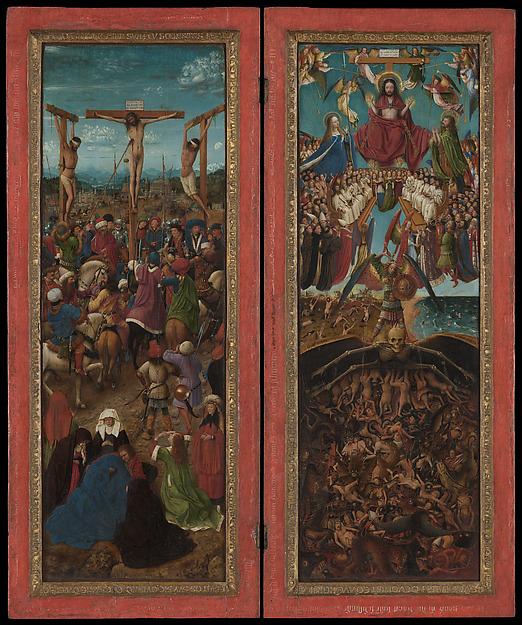
Image title: The Crucifixion; The Last Judgment
Medium: Oil on canvas, transferred from wood
Date: ca. 1436–38
Source:
The Met Collection
“
Science investigates; religion interprets. Science gives man knowledge which is power; religion gives man wisdom which is control.
”
— Martin Luther King Jr.
Ultraviolet Truths: What Science Reveals Beneath Historical Paintings
Introduction: Light Beyond the Canvas
Art has always invited us to look beneath the surface—emotionally, intellectually, and now, quite literally. Thanks to cutting-edge imaging techniques like infrared reflectography and X-ray fluorescence (XRF), we have entered a new era of understanding the secrets hidden under layers of paint. These technologies illuminate the artistic process, uncover lost compositions, and even challenge long-held attributions. Across centuries and cultures, the marriage of art and science is rewriting art history, one scan at a time.
1. Renaissance Revelations: The Artist’s Hidden Hand
The Renaissance is often idealized as a time of perfected technique and divine proportion, but scientific imaging reveals something much more human. Infrared reflectography, which captures carbon-based underdrawings invisible to the naked eye, allows us to witness artists like Leonardo da Vinci and Jan van Eyck sketching directly on panel — often changing their minds as they worked. For example, under Leonardo’s ‘Lady with an Ermine’, scientists found initial positioning of the animal and even subtle modifications to the lady’s facial expression. These pentimenti, or hidden revisions, personalize the painting, reminding us that even the masters deliberated and experimented.
2. Baroque Layers: Patronage, Politics, and Painted Revisions
In the Baroque period, art became a powerful tool for propaganda and prestige, often shaped by the desires of wealthy patrons. X-ray imaging of Rubens’ works has unearthed dramatic compositional changes, suggesting that he sometimes altered his works to suit political intentions or shifting commissions. One famous instance is Rubens’ ‘The Triumph of the Eucharist’ tapestry series, in which overpainted elements reveal religious iconography added or subtracted depending on the recipient kingdom’s allegiance. The revelation that these grand gestures of faith and empire had multiple drafts underscores how visual art was entangled with power and persuasion.
3. Romanticism and Realism: Sketching with Emotion
The 19th century saw a pivot from idyllic mythologies to emotional intensity and social commentary. Scientific imaging shows how Romantic and Realist artists wove emotion into process. For instance, infrared analysis of Géricault’s preparatory work for ‘The Raft of the Medusa’ reveals a grid of charcoal and notable changes in the position of the figures—particularly the torsos pointing toward salvation. Meanwhile, XRF on Courbet’s ‘The Stone Breakers’ reveals underpainted structures and studies that denote a laborious realism intentionally constructed, not just captured on sight. Such scientific peeks affirm that spontaneity in this period was often the reward of meticulous planning.
4. Modernist Experiments: Artists as Scientists
By the early 20th century, with innovations in paint chemistry and abstraction, artists themselves engaged with scientific thinking. Picasso’s ‘Blue Period’ works, under X-ray scrutiny, sometimes reveal entirely different compositions underneath, reflecting his transitional struggles and economic necessity—he often reused canvases. Similarly, Kazimir Malevich’s ‘Black Square’ hides an earlier Cubo-Futurist painting beneath its iconic void, visible through infrared and X-ray imaging. The idea that ground-breaking works rest atop other discarded experiments underscores modernism’s embrace of process over perfection, and symbolism over surface.
5. Contemporary Conversations: Transparency and Technology
In contemporary art, the use of imaging tools sheds light not just on the past but on an evolving dialogue between artist, material, and audience. Today’s artists sometimes intentionally embed multiple layers into digital or physical works, fully aware that future technologies might expose them. Moreover, conservators now employ hyperspectral imaging and artificial intelligence to assist in restoration and authentication, as seen in recent investigations into Rothko’s color fields and Basquiat’s enigmatic symbols. This convergence of art and technology fosters a new kind of transparency, where the unseen becomes celebrated, not concealed.
Conclusion: Reframing the Narrative
The revelations of infrared and X-ray imaging do more than astonish— they reshape our understanding of creativity, authorship, and history. These ultraviolet truths remind us that a painting is never merely an image, but a palimpsest of ideas, revisions, and intentions. As we continue to peer through the painted veil, we make visible not only forgotten layers but also the evolving story of art itself.
Useful links: