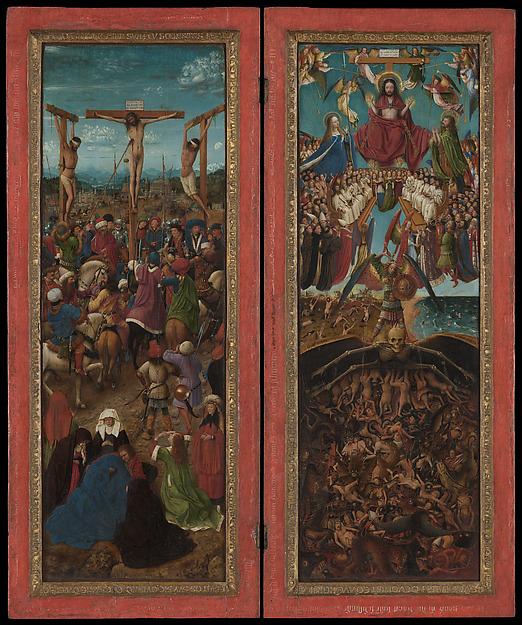
Image title: The Crucifixion; The Last Judgment
Medium: Oil on canvas, transferred from wood
Date: ca. 1436–38
Source:
The Met Collection
“
Neatness begets order; but from order to taste there is the same difference as from taste to genius, or from love to friendship.
”
— Johann Kaspar Lavater
The Color Black: Material Mysteries from Carbon to Vantablack
Introduction: Black as a Beginning, Not an Absence
In the vast palette of art history, few colors carry as much symbolic weight and material intrigue as black. Often associated with nothingness, void, or mourning, black paradoxically forms the basis of some of the most enduring and revolutionary pigments in visual art. From soot-based inks in ancient China to the nearly light-absorbing Vantablack forged in modern labs, black has evolved not just in chemistry but in meaning. This journey through the pigments of black reveals how science, culture, and art converge to create a color of profound depth and complexity.
Chapter 1: Soot and Spirit — The Origins of Black Ink in the East
Black’s journey begins in ancient China, around 2500 BCE, with the invention of ink made from soot and animal glue. Known as “lamp black” due to its method of production—collecting soot from oil lamps—this pigment was a mainstay in Chinese calligraphy and painting. The monochrome ink wash paintings of the Song and Tang dynasties used only variations of black to convey landscapes filled with mountains, mist, and philosophical depth. In traditional East Asian aesthetics, black symbolized balance and the void, aligning closely with Daoist and Zen Buddhist ideals of emptiness as a generative force.
These early uses of black were far from empty; they brimmed with nuance, showing how one color could articulate space, emotion, and form. Inks were often made into solid sticks and ground with water on a stone palette, an act as much meditative as it was preparatory, reinforcing the connection between craft and contemplation.
Chapter 2: Medieval Charcoal and the Iconography of Darkness
In medieval Europe, black took on a more symbolic and theological role. Artists used carbon-based blacks like bone black and vine black, derived from charred organic material. These early blacks weren’t just materials—they narrated moral dichotomies. In devotional paintings, dark robes on monks denoted humility, while the darkness of hell scenes embodied sin and corruption. During the Gothic and early Renaissance periods, black was not only a pigment but a metaphor. The scarcity of rich, deep black materials meant the color often had to be mixed and layered with earth pigments to produce depth, giving it a laborious, almost sacred quality.
Meanwhile, black’s cultural status was shifting. In 14th-century Italy and Burgundy, black became fashionable for the upper classes, often indicating power and sobriety. Here, we see a rare case where material limitations and societal values intertwined, influencing not just what black meant, but who chose to wear—and paint—using it.
Chapter 3: The Age of Alchemy — From Natural Pigments to Synthetic Blends
The industrial age and advancements in chemistry brought dramatic changes to how black pigments were made and understood. The 18th and 19th centuries saw innovations such as ivory black, made by charring ivory tusks, and later bone black, a more ethical alternative. These intense, velvety blacks became prized by artists like Francisco Goya, who used them in emotionally charged works such as “Saturn Devouring His Son.” These blacks weren’t only technical achievements—they also expressed the psychological undercurrents of the time, echoing Romantic ideals of the sublime and the grotesque.
At the same time, artists were becoming increasingly aware of color theory and optical perception. Black was no longer just a shade of shadow—it was a deliberate choice. With the development of synthetic pigments, artists could now manipulate darkness in new ways, giving rise to more abstract explorations, such as those seen in the works of Édouard Manet and later, Kazimir Malevich’s minimalist “Black Square.”
Chapter 4: Black in Modernism — Philosophy, Politics, and Perspective
The 20th century saw black break free from representational confines. It became a philosophical statement and a political weapon. With Malevich’s radical 1915 “Black Square,” the color became the ultimate reduction—art for art’s sake, divorced from object. Similarly, abstract expressionists like Ad Reinhardt used black-on-black compositions to explore the boundaries of perception and meditation. These works challenge the viewer to look more deeply, to recognize the artistry within subtle gradations of black.
Meanwhile, political uses of black in art—and fashion—took hold as forms of protest. The Black Panthers adopted it as their symbolic uniform. Designers like Coco Chanel elevated black to an icon of chic minimalism. Artists like Kara Walker used silhouettes to unpack racial histories, weaponizing black for narrative power. Here, black was no longer passive; it was assertive and intentional.
Chapter 5: Into the Void — Vantablack and the Controversies of Ultra-Black
In 2014, Surrey NanoSystems introduced Vantablack, the darkest man-made substance, absorbing 99.965% of visible light. Originally developed for space and military applications, its optical properties stunned the art world. Surfaces coated in Vantablack seem to lose all dimensionality, turning even sculptural forms into flattened voids. It was instantly hailed as a futuristic marvel but also sparked a fierce controversy when artist Anish Kapoor gained exclusive rights to use it in art. Other artists, notably Stuart Semple, responded with competing ultra-blacks like Black 3.0, democratizing access and raising ethical questions about ownership in art materials.
Vantablack marks not just a technological leap, but a philosophical reiteration of black as a window into the infinite. From metaphorical heaven-and-hell in medieval art to actual light-absorption technologies, we’re continually trying to define—and blur—the edges of darkness. As artists today wrestle with materials that push perception to its boundaries, black remains both destination and departure point—forever enigmatic.
Conclusion: Black’s Enduring Enigma
Black, in all its incarnations—from the smoke-choked inkrooms of ancient China to sterile nanotube-labs—reminds us that no color is so rife with contradiction. It is emptiness filled with presence; a lack that speaks volumes. Whether used to communicate solemnity, elegance, violence, or transcendence, the color black resists reduction. It is alchemical, historical, and futuristic all at once. In every era, artists return to it not just as a pigment, but as a philosophical inquiry. What is black, really? The question, like the color, remains satisfyingly open-ended.
Useful links: