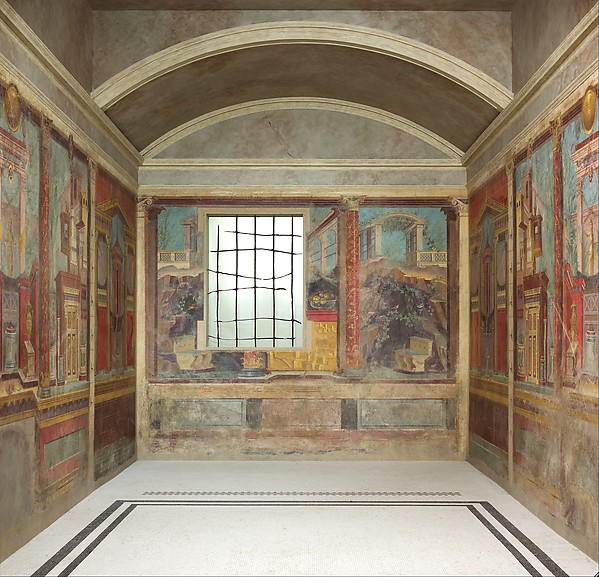
Image title: Cubiculum (bedroom) from the Villa of P. Fannius Synistor at Boscoreale
Medium: Fresco
Date: ca. 50–40 BCE
Source:
The Met Collection
“
Men of perverse opinion do not know the excellence of what is in their hands, till someone dash it from them.
”
— Sophocles
Frescoes from Below: Laborers Depicted by Their Own Hands
Introduction: A Hidden Layer in Art History
When we walk through the lofty interiors of a medieval cathedral or a colonial church in Latin America, we are often captivated by soaring ceilings, radiant saints, and scenes painted with ecclesiastical grandeur. But buried beneath layers of religious symbolism and elite-sponsored narrative lies a quieter, more human story—one painted by hands hardened by labor. These rare depictions, created not by aristocrats or artisans commissioned by the Church, but by laborers themselves, offer an invaluable window into the social fabric and lived experiences of people historically excluded from authorship in art. This article explores the few but revealing instances where laborers left their mark—literally—in frescoes, murals, and carvings across Latin America and medieval Europe. These works are not only artistic anomalies but also radical acts of visual self-representation.
Chapter 1: Medieval Europe and the Margins of Manuscripts
In the medieval European context, the visual arts were largely determined by religious institutions. Scribes and monks labored over manuscripts, while architects and master stonemasons conceptualized the grand structures we now study. Yet at the margins—both literally and figuratively—laborers occasionally inserted their own realities into these sacred spaces. Grotesques and marginalia in illuminated manuscripts, for example, often include whimsical or earthy scenes of daily toil—men plowing fields, women baking bread, blacksmiths at work. While these drawings are usually attributed to the scribes, some were created by assistants or anonymous members of the lower classes who found a rare channel for expression.
Similarly, in Gothic cathedrals like Notre-Dame in Paris or Chapelle Saint-Hubert in Amboise, stonemasons left small carvings hidden in stairwells or behind buttresses—playful, irreverent figures that contradict the gravitas of the official iconography. Though unsigned, these stone carvings carry the soul-print of those who were as much a part of the building’s creation as its benefactors. These are not only artistic embellishments but humble assertions of presence by those from below.
Chapter 2: Colonial Latin America—Syncretism and Subversion
In the aftermath of Spanish colonization, the Catholic Church established elaborate missions and cathedrals across Latin America. Often, the indigenous peoples who built these structures were not merely laborers but original artists forced to adopt European iconography. However, they did not completely erase their cultural identities. Finding clandestine opportunities for creative subversion, they embedded indigenous symbols and depictions into Christian narratives. In the Andean Baroque style of Peru and Bolivia, native flora, local dress, and even pre-Columbian deities are subtly worked into altarpieces and murals.
One of the most telling examples comes from the Church of San Pedro in Andahuaylillas, Peru—frequently called the “Sistine Chapel of the Andes.” Though designed to reinforce Catholic doctrine, the church’s murals contain visual cues and motifs distinctly Andean in character. These were not simply decorative compromises but coded acts of cultural survival and silent resistance. The indigenous laborers and artisans effectively reclaimed visual space in a spiritual and political context dominated by European standards.
Chapter 3: The Mexican Convento Murals—Voices on the Wall
Following the Spanish conquest, friars built itinerant mission conventos throughout Mexico to convert and educate indigenous communities. The murals that adorn these early religious structures, especially in regions like Oaxaca and Puebla, tell a more complex story than their overt religious content suggests. Scholars believe that many of these frescoes were painted by indigenous artists trained in European techniques through evangelization schools. However, they often included vernacular stories, agricultural labor scenes, and images portraying their own identities and collective memory.
In the convent of San Nicolás in Actopan, for instance, scholars have identified scenes revealing not only biblical narratives but also quotidian scenes such as maize cultivation and construction work. These murals were multidimensional—serving religious purposes while simultaneously allowing the laboring classes to visualize themselves within public and sacred spaces. They blended didactic imagery with genuine self-portraiture, a quiet but meaningful claim to visibility in a colonized world.
Chapter 4: Philosophical Implications—Who Gets to Make Art?
The laborer’s hand has traditionally been seen as a tool rather than a vehicle of authorship, particularly in societies where hierarchy and craft separation were stark. The instances where laborers depicted themselves or aspects of their lives push back against Cartesian divides between mind and body. These works challenge long-held Western dualisms that separate intellectual labor (design, composition, meaning) from manual labor (execution, fabrication).
These rare but powerful frescoes function not only as artistic expressions but as philosophical counter-narratives. They question assumptions about value, authorship, and historical memory. Who gets to be remembered, and who writes history—even visually? When those at the bottom of the social ladder inscribe their experiences onto a wall, they transform it from a site of passive labor to one of active meaning-making. In doing so, they become not just subjects of history but its authors.
Chapter 5: Technology and the Democratization of Visual Expression
Fast forward to the modern era, and we find echoes of these historical patterns in digital and street art—a democratization that recalls those first, hidden frescoes by laborers. Just as medieval stonemasons carved their truths behind cathedral walls, today’s graffiti artists and muralists in marginalized communities use public walls to document lived realities. Portable technologies, open-source design platforms, and digital tools now offer working-class creators spaces where they can tell their stories without institutional gatekeeping.
Notably, in contemporary Latin America, community muralism thrives in working-class neighborhoods where artists—many of whom are themselves laborers—rehabilitate urban spaces through collective imagery. These echoes suggest a continuity of intent, if not of form. From stone carvings hidden behind chancel screens to digital stencils sprayed on crumbling city walls, the laborer’s hand continues its quiet assertion of dignity and presence.
Conclusion: Art from Below as a Living Tradition
The frescoes, murals, and carvings examined here may be scarce, but their impact is profound. They remind us that history is not only written by victors or the elite. Sometimes, it’s painted in ochre and lime by a mason on lunch break. “Frescoes from below” are testaments to the resilience of human expression, even under constraint. In a world increasingly alert to diverse narratives, recognizing the laborer’s mark is not only an act of historical justice but a reaffirmation of art’s fundamental purpose—to reflect and sustain the lives of its creators.
Useful links: