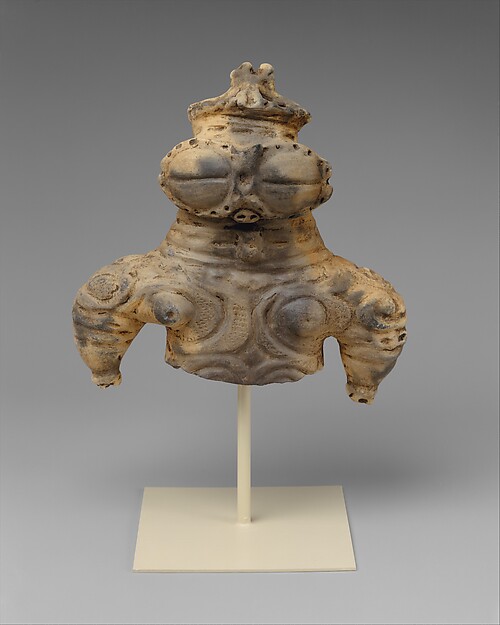
Image title: Dogū (Clay Figurine)
Medium: Earthenware with cord-marked and incised decoration (Tōhoku region)
Date: 1000–300 BC
Source:
The Met Collection
“
Permanence, perseverance and persistence in spite of all obstacles, discouragements, and impossibilities: It is this, that in all things distinguishes the strong soul from the weak.
”
— Thomas Carlyle
Tattooed Statues: Body Art Permanence From Samoa to Silicon Valley
Introduction: Marking the Skin, Carving the Self
Throughout human history, the body has served as both canvas and sculpture—a medium for inscribing identity, status, and belonging. From the richly symbolic tattoos of Polynesia to the cutting-edge biometric skin sensors of Silicon Valley, the surface of the body reflects deeper meanings of who we are and how we connect to the world. This blog explores the sculptural parallels between traditional Polynesian tattoo practices and contemporary biometric art, tracing how the permanence and symbolism of body markings have evolved across time and technologies.
1. Polynesian Traditions: The Sacred Geometry of Identity
In the islands of Samoa, Tonga, and other parts of Polynesia, tattooing—known as tatau—is a sacred social practice, deeply embedded in spiritual, genealogical, and communal identity. The process itself is sculptural: using bone or tusk tools dipped in carbon-based ink, tattoo artists hammer geometric patterns into the skin. These designs often cover the body in symmetrical, architectural layers, echoing notions of order, cosmology, and lineage.
The male pe’a and female malu tattoos are not just decorative; they are societal roles etched into flesh. The pain and permanence of these tattoos symbolize endurance and honor. In this light, the tattoo becomes a static sculpture— a living monument of commitment, one that transforms the human body into a narrative vessel.
2. Greco-Roman Marble and the Myth of Purity
Contrasted with Polynesian body art, classical Greco-Roman sculpture idealized a polished and often unmarked human form. The emphasis was on symmetry, proportion, and flawless surface—aspirations to divine forms free from the blemishes of mortal life. In art history, this idealism created a persistent bias against bodily markings, viewing them as impurities or barbaric practices.
Interestingly, many ancient Roman slaves and soldiers bore tattoos for identification—an inversion of status and aesthetics. These marks were utilitarian, not celebrated. Yet, the tension between pure sculptural surface and the real, marked human body created fertile ground for philosophical discourse: can the soul—or social essence—be made visible through the skin?
3. The Renaissance Body: Anatomical Precision Meets Inner Identity
During the Renaissance, artists like Leonardo da Vinci and Michelangelo reinvigorated interest in the human body—not merely as an outer shell but as a vessel for inner truths. Anatomical studies elevated skin to a crucial interface between external perfection and internal complexity. Though tattooing remained taboo in European society, artists began pondering the relationship between surface and depth in new ways.
Sculpture in this era often revealed tension in musculature and emotion—suggesting that the body could itself be expressive beyond simple form. These conceptions laid intellectual foundations that modern body artists and tech developers continue to build upon today: the body as an active participant in expressing individuality and meaning.
4. Biometric Skin: Tattoos in the Age of Technology
Fast forward to the 21st century, and skin has become a digital interface. Researchers at institutions like MIT and companies in Silicon Valley are developing biometric tattoos—smart skin technologies that can monitor heart rate, hydration, blood sugar, or even moods through nano-sensors and conductive inks. These wearable, and sometimes implantable, devices blur the lines between art, health, and interface.
While these tools may lack the spiritual depth of Polynesian traditions, they hold a different type of permanence. A biometric tattoo marks you in the language of data—translating corporeal presence into real-time feedback. Philosophically, this modern practice revives long-standing themes: inscription, permanence, and the role of the body in manifesting invisible truths, now data-centric rather than divine.
5. Neo-Tribalism and the Hybrid Aesthetic
The resurgence of tattoo culture in the West—especially neo-tribal styles—reveals a hunger to reconnect with ancestral forms of identity-making. Artists today often blend Polynesian motifs with technological precision, crafting tattoos that straddle traditional craftsmanship and modern aesthetics. Simultaneously, technologists draw inspiration from tribal patterns to design more intuitive, body-friendly interfaces.
Hybrid works, such as those by artist Stelarc who implants sensors and mechanical elements into his body, push the envelope. They raise questions about the limits of body modification and sculpture. Is the cyborg a new kind of statue—one that evolves and transmits? As digital permanence overlays inked skin, we are reminded that the body remains central to art’s oldest questions: Who are we? What do we endure? What do we choose to show or hide?
Conclusion: The Future is Skinned
From the rhythmic chisel of Polynesian tattooing tools to micro-scaled biometric interfaces, the skin continues to be our most revealing sculpture. It is a living document—etched, inked, encoded—with personal, spiritual, and now digital significance. The parallels between traditional body art and emerging technologies suggest a cyclical return to the body as a site of truth, identity, and transformation. In a world increasingly obsessed with the virtual, perhaps it is the enduring materiality of skin—scarred or sensor-laden—that remains most human.
Useful links: