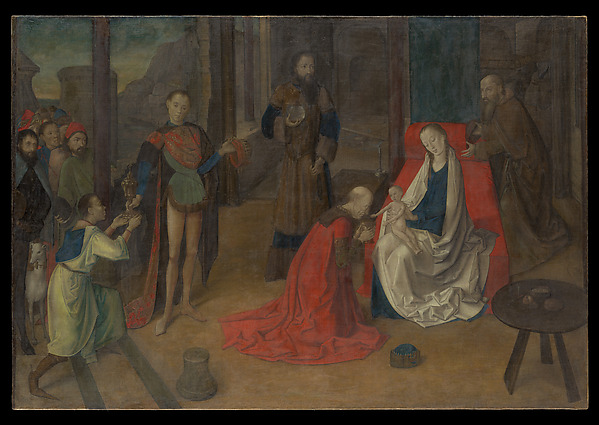
Image title: The Adoration of the Magi
Medium: Distemper on canvas
Date: 1472–74
Source:
The Met Collection
“
Be slow to fall into friendship; but when thou art in, continue firm and constant.
”
— Isocrates
Fossils or Fakes? When Art Historians Play Archaeologist
Introduction: Where Art Meets Science
Once confined to connoisseurship and intuition, art authentication has entered a new technological frontier. Art historians today resemble crime scene investigators, using advanced scientific tools to discern truth from forgery. From radiocarbon dating to X-ray fluorescence, science now plays a pivotal role in the murky world of art attribution. This fusion of technology and hermeneutics has not only helped unveil modern fakes but also rewritten our understanding of genuine ancient masterpieces. In this article, we unpack how different eras in art history have collided with modern science to either uphold or unravel their mysteries.
Chapter 1: Classical Antiquity – Secrets in Stone and Pigment
The art of ancient Greece and Rome was long considered untouchable, its authenticity rarely challenged until discrepancies in style or material raised eyebrows. One of the most telling cases involved the so-called “Etruscan Warriors” at the Metropolitan Museum of Art. Initially heralded as remarkable antiquities, these sculptures fell under suspicion in the 1960s for their uncharacteristic features. When thermoluminescence dating—a technology that measures the last time material was heated—was conducted, the results were damning: they were modern creations, likely forged in the 19th century. Such discoveries ushered in a new era where even museum mainstays were no longer above scrutiny.
Chapter 2: The Renaissance Under the Microscope
Forgeries of Renaissance art are especially beguiling due to the public’s appetite for works by masters like Leonardo, Michelangelo, and Raphael. One notorious case was the “La Bella Principessa,” a portrait initially attributed to Leonardo da Vinci. Skepticism grew when pigment analysis revealed the use of modern materials not available in the 15th century. Digital imaging also showed inconsistencies in the layering technique. Yet others argued that Leonardo was an innovator who could have experimented with materials. This debate highlights not only the scientific challenges in art history but also the philosophical question of whether authenticity lies purely in materials or also in the creative spirit.
Chapter 3: Baroque and the Birth of Infrared Authentication
The monumental compositions of the Baroque period, characterized by theatricality and dynamic movement, presented new challenges for authentication. For example, the rediscovery of a work attributed to Caravaggio sent ripples through the art world. Skeptics doubted its origin until multispectral imaging revealed an underdrawing linked stylistically to the master. Infrared reflectography unearthed fragments and corrections typical of Caravaggio’s known working methods, suggesting it was more than a copy. The use of such technology enables historians not only to confirm authenticity but also to peer into the artist’s process—transforming how we understand the act of creation itself.
Chapter 4: Modernism and the Rise of the Master Forger
The 20th century introduced mass production, shifting tastes, and a booming art market—all of which provided fertile ground for forgers. Perhaps no modern forger looms larger than Han van Meegeren, who fooled the world into believing he had discovered lost Vermeers. Using materials intentionally aged and mixed to mimic historical techniques, he created plausible pastiches. However, when pigment analysis revealed synthetic ultramarine (a pigment not available in the 17th century), the illusion crumbled. The van Meegeren case underscored how even a deep understanding of old techniques could not withstand the scrutiny of chemistry.
Chapter 5: Contemporary Art and New Technologies
Authentication in contemporary art involves a unique paradox: the artist may still be alive, yet the market is riddled with counterfeit works. Street artist Banksy’s anonymity, for instance, complicates provenance. Blockchain technology and digital watermarks have emerged as cutting-edge tools in tracking ownership and verifying authorship. At the same time, techniques like 3D scanning allow experts to compare surface textures down to the micron. These developments are transforming not just authentication but also the definition of what qualifies as “original” in a digital age where duplicability is the norm.
Conclusion: Truth in the Age of Algorithms
As the boundaries between archaeology, chemistry, machine learning, and art history continue to blur, so too does the line between what we perceive as genuine or fake. Scientific tools give art historians the precision of archaeologists, but truth in art is as much about story and context as it is about materials. What remains constant is our yearning for authenticity—not just in artworks, but in the narratives they carry through time. In unveiling fakes, we paradoxically deepen our appreciation for the real, the rare, and the remarkable.
Useful links: