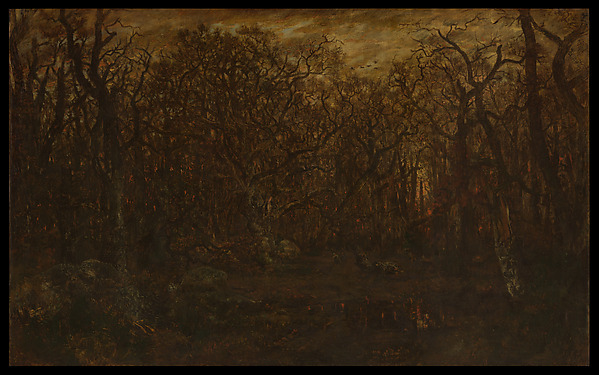
Image title: The Forest in Winter at Sunset
Medium: Oil on canvas
Date: ca. 1846–67
Source:
The Met Collection
“
To understand the heart and mind of a person, look not at what he has already achieved, but at what he aspires to do.
”
— Kahlil Gibran
‘What If He Lived?’: Basquiat at 63 in an Alternate Art History
Introduction: A Life Interrupted
Jean-Michel Basquiat’s meteoric rise and tragic fall at age 27 left the art world wondering what could have been. Equal parts prodigy and provocateur, Basquiat’s neo-expressionist canvases confronted race, power, and mortality with a raw, poetic intensity. But what if he hadn’t died in 1988? What would Basquiat, at 63 years old in 2024, have to say—about police brutality, cultural appropriation, NFTs, or the global rise of Black consciousness? In this speculative journey, we imagine how Basquiat’s voice and artistic evolution might have traversed key transformations in the history of contemporary visual art.
Chapter I: The 1990s – Reinvention in a Globalizing Art Scene
The 1990s witnessed the fall of the Berlin Wall, the birth of the internet, and a newly globalized art market. In this alternate timeline, Basquiat emerges from addiction, perhaps aided by increasing awareness of mental health and artist support systems. He begins to travel—exhibiting in Berlin, Johannesburg, and São Paulo—resonating with local histories of racism and colonialism. Influenced by European graffiti styles, Fluxus experiments, and early online art collectives, his works shift from frenzied urgency to controlled complexity. His vibrant symbols still collide, but the themes grow denser, more multilingual, echoing the polyphony of a connected world.
Chapter II: The 2000s – Diasporic Identity and Digital Frontiers
As the new millennium dawns, Basquiat becomes a mentor figure. He collaborates with emerging artists of color, especially in Africa, the Caribbean, and Southeast Asia. The rise of identity politics and post-colonial theory deepens his vocabulary. He reinterprets his signature crowns and skeletal figures through themes of migration and diaspora, contrasting ancestral memory with global capitalism. Technologically, Basquiat experiments with digital media—perhaps creating early net art, generative video loops, or even virtual gallery installations. Like William Kentridge and Kara Walker, he uses temporal layering to explore historical incompleteness. The canvas no longer confines him; his art lives in pixels and timecodes.
Chapter III: The 2010s – Political Reckonings and Cultural Reclamation
The deaths of Trayvon Martin, Michael Brown, and George Floyd rekindle Basquiat’s fire. His art, always political, becomes activist. Collaborating with movements like Black Lives Matter and Decolonize This Place, he produces monumental street murals, augmented reality installations, and viral protest images. His collaboration with musicians like Kendrick Lamar and Solange bridges visual and sonic resistance. Simultaneously, the art establishment begins to reevaluate its canon. Museums court Basquiat not merely as a commodity but as a prophet. His work becomes a symbol of the institutional change he longed for in the 1980s.
Chapter IV: The 2020s – The Age of the NFT and AI
In our current decade, Basquiat would likely stand at the edge of innovation. Initially skeptical of NFTs, he’d eventually embrace them—not as commodities, but as vehicles for subversion. Picture him minting one-of-a-kind visual poems that disappear after viewing, or releasing politically charged “ghost paintings” that exist only when a protest hashtag trends. Incorporating AI tools, he might partner with technologists to expose algorithmic bias or reclaim African diasporic dataembeddings. His work remains emotionally chaotic—but his toolkit now includes code and blockchain. Philosophically, he plays with themes of digital immortality, echoing his own brush with early death. Now, in his sixties, he becomes a shaman of the cyborg age.
Chapter V: Legacy Revised – Basquiat as Elder, Oracle, and Architect
In this alternate present, Jean-Michel Basquiat is not a youthful martyr but an elder statesman of art. His retrospectives blend physical and digital. He’s interviewed by Chimamanda Ngozi Adichie and given honorary degrees in philosophy and visual anthropology. He launches a foundation for urban artists and lectures on post-colonial aesthetics in Dakar and New Delhi. His critiques—once wrapped in color and chaos—are now delivered in conversation, essays, and virtual salons. Yet his fundamental drive endures: to make the invisible visible, to tear institutional seams, and to re-crown the figures long decentered. Basquiat at 63 is not a relic but a renaissance.
Conclusion: A Living Legacy
To consider Basquiat as a living artist today is to reimagine not just a life, but an altered trajectory of art history. He would have grown with the movements he helped foreshadow—identity, hybridity, activism, and digital intuition. While the myth of his lost genius fuels marketmania, perhaps a living Basquiat might have offered something far more powerful: a sustained evolution of vision. We may never know how he would have lived, but we can continue to listen closely to the echoes he left behind—and those that hum, still, in the possibility of his future.
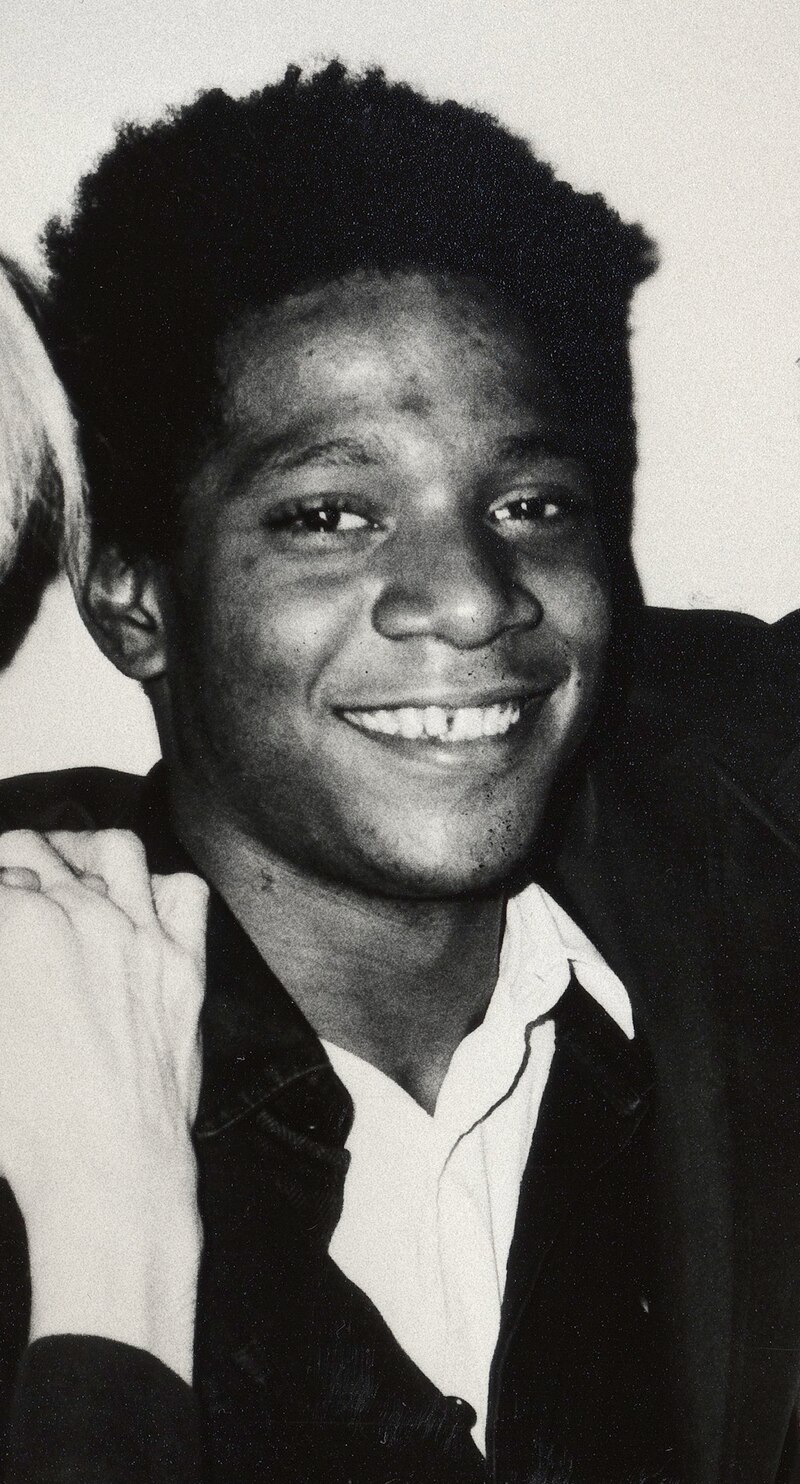
Image description:
Jean-Michel Basquiat (New York, 1984)
License:
CC BY-SA 4.0
Source:
Wikimedia Commons
Useful links: