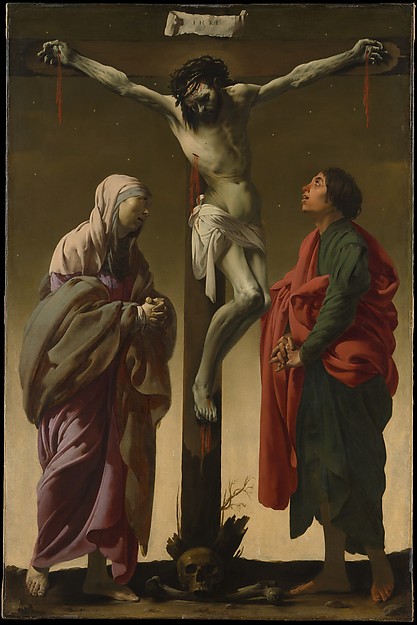
Image title: The Crucifixion with the Virgin and Saint John
Medium: Oil on canvas
Date: ca. 1624–25
Source:
The Met Collection
“
The art challenges the technology, and the technology inspires the art.
”
— John Lasseter
The Grand Evolution: A Journey Through the History of Visual Art
Introduction: Art as Humanity’s Mirror
From the earliest handprints on cave walls to the immersive digital landscapes of today, visual art has chronicled, challenged, and celebrated the human condition. Each era in art’s long journey reflects not just advances in technique or material but also the shifting tides of culture, philosophy, and technology. Let us embark on a captivating exploration through five transformative chapters in art history, tracing the evolution of creativity and self-expression across millennia.
I. The Dawn of Expression: Prehistoric and Ancient Art
The story of visual art begins tens of thousands of years ago in flickering torchlight on rocky canvases. Early humans in places like Lascaux and Altamira documented their worlds with animal figures, handprints, and enigmatic symbols. These primitive renderings were more than decoration—they were acts of communication, ritual, and even survival. As civilizations blossomed in Egypt, Mesopotamia, and Greece, art became a vehicle for recording religious beliefs, political power, and humanity’s fascination with the divine. Monumental sculptures, intricate ceramics, and vibrant frescoes gave physical form to myth and authority, each culture imprinting its identity in stone and pigment.
II. The Spiritual and the Sublime: Medieval to Renaissance Transformation
The collapse of ancient empires ushered in centuries shaped by spiritual symbolism. In Medieval Europe, illuminated manuscripts, stained glass windows, and icon paintings shimmered with gold and saturated color, conveying biblical stories to largely illiterate populations. Art was didactic and devotional, its primary purpose to inspire awe and reinforce the omnipresence of the sacred. Yet by the 14th and 15th centuries, curiosity and humanism ignited the Renaissance, as thinkers and artists rediscovered the power of observation and individuality. Pioneering figures like Leonardo da Vinci and Michelangelo harmonized classical knowledge with innovative techniques—linear perspective, chiaroscuro, anatomical accuracy—elevating art to a new plane of realism and intellectual ambition.
III. Enlightenment, Revolution, and the Age of Reason
The Enlightenment era unleashed an explosion of new ideas about science, reason, and human rights, and art could not remain unaffected. Portraits, landscapes, and genre scenes became vehicles for personal and political narratives. Movements like Neoclassicism looked backward to the order and rationality of ancient Greece, while Romanticism soon countered with a celebration of emotion, nature, and the sublime. The 19th century was a crucible of invention—artists like Turner and Delacroix challenged conventions with turbulent brushwork and bold color, while the rise of photography forced painters to reconsider the very purpose of painting.
IV. Breaking Boundaries: Modernism and Beyond
The 20th century was a period of relentless experimentation and radical change. From Cubism’s fractured perspectives to the dreamscapes of Surrealism, from the pure abstraction of Kandinsky to Pop Art’s playful reverence for commercial culture, artists dismantled old systems and remade art in their own images. War, new media, and social upheaval challenged artists to bear witness and provoke dialogue, while breakthroughs in paint, reproduction, and global communication expanded the possibilities of expression. The boundaries of ‘art’ blurred and dissolved, inviting everyone from Dada pranksters to Abstract Expressionists to join the creative fray.
V. The Digital Renaissance: Contemporary Art and the Future
Today, the democratization of art and the rise of digital technology have reshaped creation and consumption. Virtual reality, artificial intelligence, and social media have become new frontiers for artists to explore identity, memory, and reality itself. Street art, installation, and interactive works dissolve the border between artist and audience. Meanwhile, global voices, once marginalized, are amplified, making contemporary art a sprawling, inclusive conversation that defies easy definition. The creative tools of tomorrow—augmented reality, bio-art, NFTs—promise to further expand what art can be and whom it can reach. As always, art remains the living mirror of our collective dreams, fears, and imagination.
Conclusion: Art’s Unending Journey
Each transformation in the history of visual art tells a story not just of artistic genius but of enduring human inquiry. As technology, society, and philosophy continue to evolve, art will persist at the vanguard—challenging our perceptions, catalyzing change, and celebrating the inexhaustible wonder of creation.

Image description:
title page of the book Art as a factor in the soul’s evolution by Curuppumullage Jinarajadasa
License:
Public domain
Source:
Wikimedia Commons
Useful links: