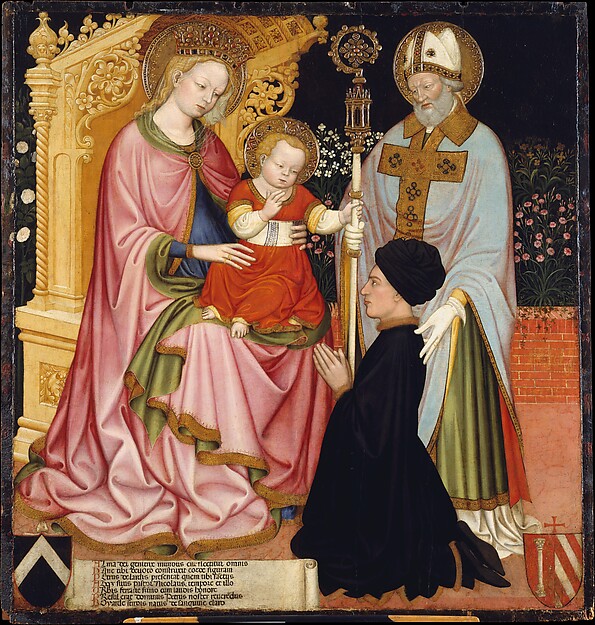
Image title: Madonna and Child with the Donor, Pietro de’ Lardi, Presented by Saint Nicholas
Medium: Tempera and gold on wood
Date: ca. 1420–30
Source:
The Met Collection
“
Never mistake motion for action.
”
— Ernest Hemingway
From Fresco to Frame-by-Frame: Renaissance Motion Before Cinema
Introduction: The Idea of Movement Before the Movies
Long before the flicker of the silver screen, artists were already experimenting with the illusion of movement. The human fascination with depicting time and motion stretches back thousands of years—to Paleolithic cave paintings that show animals in multiple stances, suggesting rudimentary animation. But it was during the Renaissance that this quest took on new complexity, as painters, sculptors, and architects sought to capture not only light and perspective but also the flow of action itself. This is the story of how motion was imagined, constructed, and ultimately set in motion—centuries before cinema.
Chapter I: Ancient and Medieval Roots of Sequential Vision
Even before the Renaissance, artists had toyed with sequential narrative. Ancient Egyptian tombs displayed processions and battles unfolding across registers, while Roman murals captured action in vibrant freeze-frames. In the Middle Ages, illuminated manuscripts continued this storytelling tradition, visually guiding viewers through sacred narratives panel by panel. These visual sequences, while static, were vital steps toward understanding time as something that could be represented visually. The human eye was trained to interpret spatial continuity as temporal progress—a crucial cognitive bridge to the cinematic mindset that would arise much later.
Chapter II: The Renaissance Revolution—Perspective and Time
The Renaissance transformed Western art by introducing mathematical perspective and a new conception of human experience rooted in realism and the senses. Artists like Masaccio and Piero della Francesca expanded pictorial depth, allowing space to unfold like a stage upon which stories could play out. In frescoes such as Masaccio’s ‘The Tribute Money,’ the same figures appear more than once within a single composition, representing different moments in time. This was, in essence, a proto-cinematic sequence: a single image containing multiple episodes. Philosophically, it reflected the Renaissance humanist belief that man could perceive, organize, and interpret time rationally—an idea as revolutionary as perspective itself.
Chapter III: Sequential Storytelling and the Optical Imagination
By the sixteenth century, artists were refining this illusion further. Narrative fresco cycles by masters like Ghirlandaio and Giotto before him laid out entire biographies across chapel walls, commanding viewers to ‘read’ images as they would a text. Meanwhile, Leonardo da Vinci’s sketches obsessively searched for the moment between stillness and motion. His studies of flowing water, fluttering birds, and muscle anatomy anticipated both animation and cinematography. Leonardo’s belief that “motion is the cause of life” was not only scientific but also aesthetic—an insight into the dynamic essence of perception itself.
Chapter IV: Baroque Dynamism—Painting in Motion
The Baroque period unleashed motion from its static cage. Artists like Caravaggio, Rubens, and Bernini infused their works with energy, spiraling forms, and dramatic lighting that suggested instantaneous movement. Caravaggio’s chiaroscuro amplified gestures, while Rubens’ bravura brushwork seemed to pulsate with vitality. Bernini’s sculptures, such as ‘Apollo and Daphne,’ captured transformation mid-act, each marble fold and twist evoking frames of an invisible film. The Baroque artist didn’t just depict motion—he orchestrated it, turning the viewer into an active participant in a rhythmic visual drama.
Chapter V: The Pre-Cinematic Spirit and Technological Imagination
As scientific discoveries expanded the understanding of optics and perception, so too did artistic techniques evolve. Devices like the camera obscura, widely used by Dutch painters, offered a mechanical lens through which reality could be reframed, anticipating the photographic principle. In the eighteenth and nineteenth centuries, experiments with optical toys—the thaumatrope, zoetrope, and magic lantern—finally gave form to moving images. Yet these inventions did not emerge out of nowhere; they were the technological descendants of centuries of painters and sculptors who had pursued the illusion of motion with brush and chisel.
Conclusion: The Eternal Dance of Vision and Time
The Renaissance pursuit of depicting time and motion was not simply about technique—it was about understanding life itself as flux and transformation. The desire to freeze time even as it flows, to tell temporal stories in spatial form, is one of humanity’s most enduring creative impulses. When cinema finally arrived, it did not create motion; it revealed what artists had long known—that the eye, the mind, and imagination together can make a still image move.
Useful links: