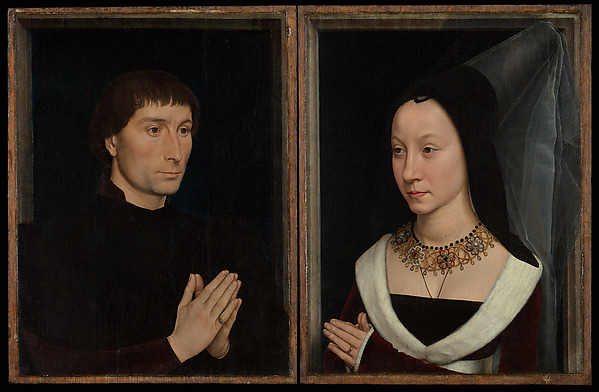
Image title: Tommaso di Folco Portinari (1428–1501); Maria Portinari (Maria Maddalena Baroncelli, born 1456)
Medium: Oil on oak
Date: ca. 1470
Source:
The Met Collection
“
Setting an example is not the main means of influencing another, it is the only means.
”
— Albert Einstein
Quantum Brushstrokes: How Physics Is Influencing Contemporary Painting
Introduction: Painting in the Age of Quantum Thought
In the early 21st century, as quantum physics continues to reshape our understanding of reality, its influence has quietly extended beyond laboratories and theoretical papers—into the studio. Painters across the world are beginning to interpret quantum mechanics not as a scientific system to be illustrated, but as a language of uncertainty, fluidity, and entanglement that mirrors our contemporary consciousness. From large-scale abstract works to subtle explorations of perception and materiality, a new wave of ‘quantum artists’ are translating the physics of possibility into visual form.
Section 1: From Classical Certainty to Modern Fragmentation
To understand the quantum painter’s impulse, we must first revisit the early 20th century, when visual art began its own revolution alongside physics. The discovery of relativity and the birth of quantum theory broke apart the solid world that classical physics had built. Simultaneously, movements like Cubism, Futurism, and Surrealism unraveled pictorial space, replacing the singular viewpoint with multiple dimensions of time, vision, and experience. Just as Werner Heisenberg’s principle of uncertainty destabilized the idea of fixed reality, Picasso fractured perspective on his canvas. Modern art and modern physics both challenged the notion of a stable, objective truth.
Section 2: The Mid-Century Fusion of Science and Vision
The mid-20th century saw art and science enter a fascinating partnership. Abstract Expressionists such as Jackson Pollock and Mark Rothko were not consciously informed by quantum theory, yet their embrace of spontaneity, chance, and immaterial presence resonates strongly with it. Later, artists associated with Op Art and the avant-garde—like Bridget Riley or Victor Vasarely—brought perceptual ambiguity to the forefront, exploring how observation itself could shape visual reality. This coincided with a cultural shift toward systems thinking, cybernetics, and the early computer age, all of which mirrored quantum ideas of interconnectedness and fluid states.
Section 3: Postmodern Entanglements—Reality as a Network
By the 1980s and 1990s, the term ‘quantum’ had become almost mythic in culture. Artists began to treat reality as a web of information rather than a fixed object. Installation artists like Olafur Eliasson and Anish Kapoor created works that dissolved material boundaries, inviting viewers to experience light, space, and their own perception as interwoven. In these decades, the language of physics resonated deeply with postmodern philosophy: the idea that truth is relational, that the observer alters the observed. Painters of this period, influenced by conceptualism and the emerging digital realm, began to treat paint not as substance but as an interface between worlds—visible, invisible, and virtual.
Section 4: The Quantum Aesthetic in the Contemporary Studio
Today’s painters embrace quantum language with both poetic freedom and technological awareness. Artists such as Yayoi Kusama, Tomás Saraceno, and Marina Abramović—though working in different media—embody ideas of superposition, repetition, and interconnectedness. Advanced materials, nanotechnology, and algorithmic tools allow for the manipulation of surfaces and pigments in ways that mimic wave-particle duality: shimmering textures that change with the angle of observation, holographic pigments that dissolve certainty. Painters explore the moment between presence and disappearance, between image and potential. The canvas becomes a site of probabilities—a quantum field of pigment, light, and consciousness.
Section 5: Beyond Metaphor—Art as Quantum Inquiry
As physics grows ever stranger, contemporary painting becomes not just inspired by quantum ideas, but aligned with them in purpose. Rather than depicting reality, many artists now seek to enact it: to build systems that reflect the entanglement of all things. Virtual reality installations, AI-aided painting algorithms, and interactive pigments that change under different environmental conditions all point toward a practice of painting that perceives itself as part of a larger quantum continuum. The artist, like the physicist, becomes a co-creator in an unfolding universe of probabilities. The brushstroke is no longer a statement—it is a question vibrating through uncertainty.
Conclusion: The Future Spectrum of Quantum Art
Quantum-inspired painting is a reminder that art and science share a single goal: to understand what it means to exist in a universe that resists simplicity. The painters of our age, engaging with the language of quantum physics, invite us to see reality not as fixed or knowable, but as radiant with mystery. In their shimmering canvases and dissolving forms, we glimpse the future of art—one where every color, every particle, and every idea is simultaneously many things at once.
Useful links: