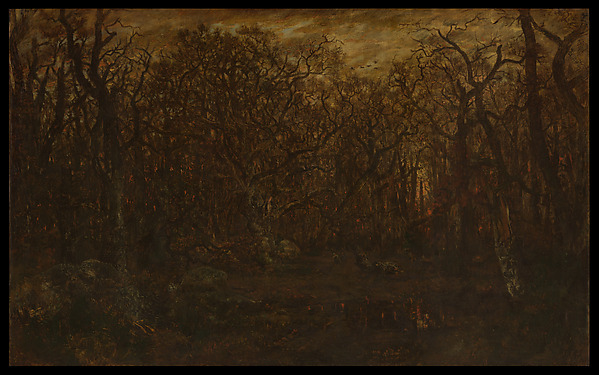
Image title: The Forest in Winter at Sunset
Medium: Oil on canvas
Date: ca. 1846–67
Source:
The Met Collection
“
The art challenges the technology, and the technology inspires the art.
”
— John Lasseter
Plastic Politics: How Environmental Crises Shape 21st-Century Art Materials
Introduction: The New Material Crisis
At the dawn of the 21st century, art found itself at an ecological crossroads. As the world grappled with mounting environmental crises—from oceanic plastic pollution to industrial waste—artists began reimagining their materials. The notion of the ‘noble medium,’ once reserved for marble, bronze, or oil paint, expanded to include discarded plastics and synthetic residues. This revolution not only challenged aesthetic traditions but also forced society to confront the uncomfortable legacy of consumption and waste. From installations made of ocean debris to sculptures molded from recycled polymers, contemporary artists are crafting beauty from disaster, turning material contamination into cultural commentary.
Chapter I: The Material Heritage of Art
To understand the shift to synthetic and recycled materials, we must first revisit the lineage of art’s material history. In antiquity, marble stood as the ultimate expression of permanence and purity, a metaphor for humanity’s desire to immortalize beauty. The Renaissance exalted oil paint for its luminosity and flexibility, while the Industrial Age celebrated the innovative use of iron and steel in sculpture. Materials always embodied cultural ideals—durability, mastery, progress. By the late 20th century, however, the very materials that once symbolized civilization’s triumph began to symbolize its excesses. The emergence of plastic as a ubiquitous, cheap, and artificial substance mirrored an age of disposability, setting the stage for art’s confrontation with waste.
Chapter II: Post-War Innovation and the Birth of Plastics in Art
After World War II, plastic became synonymous with the modern world—light, malleable, colorful, and infinitely replicable. Artists such as Claes Oldenburg and Eva Hesse experimented with rubber, latex, and fiberglass, pushing the boundaries of what sculpture could mean. Hesse’s works, for instance, highlighted fragility and impermanence, foretelling the decay that polymers would endure over time. Plastic entered art as both a marvel of technology and a critique of its unattainable purity. By integrating synthetic materials, artists reflected a cultural tension between progress and pollution—a paradox that would only deepen in the decades to follow.
Chapter III: The Ecological Turn in Late 20th-Century Art
By the 1980s and 1990s, environmental awareness began shaping artistic priorities. Land Art and ecological installations brought the biosphere into the heart of the gallery. Artists like Agnes Denes, who planted a wheat field in Manhattan, and Joseph Beuys, with his social sculpture ‘7000 Oaks,’ expanded the artist’s role to include environmental activism. Meanwhile, other creators turned to discarded industrial remnants as both symbol and substance. This period marked a critical turning point: waste materials ceased to be merely metaphorical; they became the raw matter of creation, embodying the very ecological dilemmas they sought to address. The medium was no longer neutral—it was part of the message.
Chapter IV: The Rise of Ocean Plastic Art
In the 21st century, ocean plastics have become a new artistic frontier. Artists such as Aurora Robson and Alejandro Durán sift through beaches and coastlines to reclaim debris for their artworks. Their practices blend activism, aesthetics, and data, converting harm into awareness. Installations like Robson’s intricate sculptural forms, reminiscent of coral reef ecosystems, translate environmental data into tangible beauty. The use of these polluted materials collapses the distance between art and activism. Technological processes—sorting, melting, 3D printing recycled plastics—introduce a new hybrid craft that connects digital innovation with ecological consciousness. The beauty lies not in the material’s purity but in its redemption.
Chapter V: Redefining the Noble Medium
Today, the idea of what counts as a ‘noble medium’ has undergone profound redefinition. Bronze and marble may still command reverence, but recycled plastic, industrial soot, and reclaimed metals carry new philosophical weight. They embody entropy, resilience, and adaptation—qualities distinctly suited for an era defined by climate change. Artists no longer seek immortality through unchanging materials, but meaning through transformation. The waste of one system becomes the foundation of another, a cycle that echoes ecological interdependence. In this sense, the artist becomes an alchemist of the Anthropocene: transforming pollution into poetry, excess into ethics, and plastic into politics.
Conclusion: The Future of Ethical Materiality
The contemporary art world now stands at the interface of aesthetics and sustainability. Institutions encourage exhibitions crafted from recycled or biologically regenerative materials. Designers and artists collaborate with scientists to create biodegradable pigments and self-repairing polymers. What once seemed marginal—eco-art, trash art, sustainable design—now shapes the mainstream conversation. The environmental crises that haunt the planet also inspire a creative renaissance grounded in responsibility and reinvention. In revaluing the detritus of modern life, 21st-century artists remind us that art has always been about transformation: of matter, of perception, and ultimately, of our collective future.
Useful links: