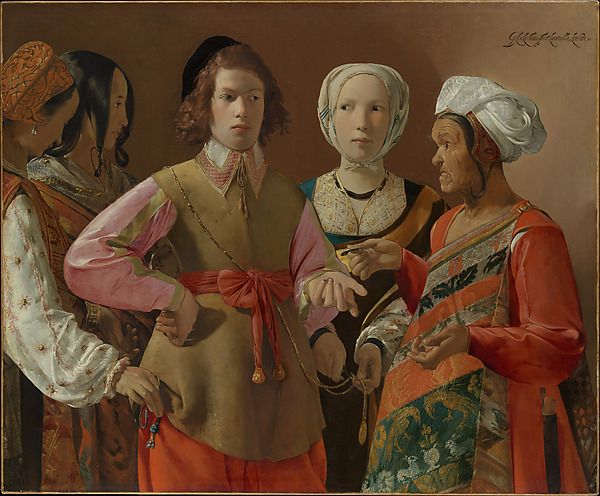
Image title: The Fortune-Teller
Medium: Oil on canvas
Date: probably 1630s
Source:
The Met Collection
“
To understand the heart and mind of a person, look not at what he has already achieved, but at what he aspires to do.
”
— Kahlil Gibran
The Quantum Brushstroke: Physics at the Heart of Abstract Expressionism
1. The Collision of Art and Science
In the decades following World War II, two great revolutions transformed how humanity understood reality: the rise of quantum physics and the emergence of Abstract Expressionism. Both disciplines questioned the predictability of nature and the limits of human perception. Artists like Jackson Pollock and Lee Krasner, working in the heart of New York, explored chaos as a principle of creation, mirroring physicists who were redefining the very nature of matter and energy.
The 1940s and 1950s marked a philosophical awakening. The certainties of the classical world—Newton’s mechanical universe and Renaissance perspective—gave way to uncertainty, spontaneity, and fields of probability. Painters began to see their canvases not as windows onto order, but as arenas where space, motion, and consciousness interacted in unpredictable ways.
2. Postwar America: The Energy of the Unseen
In the aftermath of the war, physics captured the public imagination. Einstein’s relativity, complementing quantum mechanics, had shattered the boundaries between matter and energy. This new worldview—where invisible forces governed everything from particles to galaxies—resonated with artists searching for new modes of expression free from representational limits.
Pollock’s large canvases, dripping with trails of paint, seem to map a dynamic cosmos. Each flick, drip, and gesture captures energy in motion, much like particle trajectories in a bubble chamber. Lee Krasner, meanwhile, channeled similar forces through explosive bursts of color and rhythm. Both transformed the act of painting into a performative experiment, an echo of the laboratory’s embrace of uncertainty as a path to truth.
3. Quantum Mechanics and the Aesthetics of Indeterminacy
The quantum revolution’s principles—uncertainty, probability, and the observer’s role—found visual counterparts in the techniques of Abstract Expressionism. Pollock did not work from a preconceived plan but responded moment by moment to the fluid behavior of paint. This act mirrored the quantum idea that observation collapses potential states into form; each motion of his hand crystallized a new reality on the canvas.
Critics initially struggled to articulate why these works felt alive. Harold Rosenberg famously described painting as “an event” rather than an image. From a scientific metaphor, each canvas could be seen as a field—a matrix of interactions where painter, material, gravity, and motion formed a unified system. The result was not chaos, but a visual symmetry emerging from apparent disorder, much like subatomic behavior.
4. The Cultural Web: From the Cold War to Cosmic Consciousness
Mid-century America’s fascination with physics extended beyond laboratories. Popular magazines celebrated atomic discoveries, while existentialist philosophers and artists reflected on humanity’s precarious place in the universe. Abstract Expressionism became an artistic language for this anxiety and awe, a means of grappling with invisible power—whether nuclear, psychological, or spiritual.
Lee Krasner’s art captured not only motion but the struggle for presence. Operating in a male-dominated environment, her paintings translate quantum flux into feminist resistance. The canvas became a stage where identity, energy, and emotion collided, making the unseen forces of gender and creativity visible. The cultural interplay between technology, politics, and art created one of the richest philosophical intersections of the century.
5. Legacies of the Quantum Brushstroke
Abstract Expressionism’s dialogue with physics opened pathways for later generations of artists and thinkers. The movement anticipated digital art’s fascination with algorithms and fractals—visual manifestations of complexity theory. Artists like Yayoi Kusama, Olafur Eliasson, and Julie Mehretu have extended this lineage, exploring networks, light, and motion as metaphors for the interconnectedness of all phenomena.
In retrospect, the Abstract Expressionists were not just painters; they were explorers of the invisible. By transforming uncertainty into beauty, they helped redefine what art could express in a scientific age. The quantum brushstroke—each act of chance and choice—remains a potent symbol of creativity itself: unpredictable, relational, and infinitely alive.
Useful links: