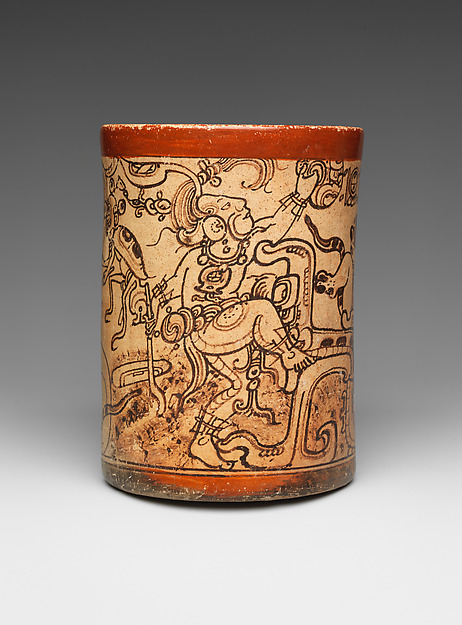
Image title: Vessel with mythological scene
Medium: Ceramic, slip
Date: 600–800 CE
Source:
The Met Collection
“
The truth you believe and cling to makes you unavailable to hear anything new.
”
— Pema Chödrön
Synesthetic Landscapes: When Painters Hear Color
Introduction: The Infinite Orchestra of Color
Imagine standing before a canvas that hums. A painting not only seen but heard—where hues of blue reverberate like cello notes and bursts of yellow flicker like violins. This is the world of the synesthetic artist: a place where senses intermingle, and sound becomes pigment. Synesthesia, a neurological condition that blends sensory pathways, has long fascinated philosophers, scientists, and artists alike. It gives rise to an extraordinary creative spectrum, transforming the act of painting into a multisensory experience. In this article, we explore how painters through history have translated sound into color, blending music and vision into a single resonant art form.
1. The Enlightenment and the Search for a Universal Harmony
In the 18th century, as Europe sought to rationalize nature through science and philosophy, artists and thinkers turned their gaze toward the relationship between sound and color. Figures such as Isaac Newton and Louis-Bertrand Castel experimented with ‘ocular harpsichords’—instruments designed to project colored light corresponding to musical notes. Castel’s invention, though mechanical in nature, sparked centuries of fascination with sensory harmony. The Enlightenment’s belief in universal correspondences between natural phenomena reflected the era’s dream of a united aesthetic science: the notion that color, tone, and form could be governed by a shared mathematical language.
2. Romanticism and the Spiritual Synesthesia of Music
By the 19th century, Romantic artists sought emotional transcendence beyond reason, embracing color and sound as vehicles for the sublime. Painters such as J.M.W. Turner and Franz von Stuck evoked atmospheric vibrations and rhythms that echoed symphonic structures. This period’s fascination with the ineffable—its yearning to visualize the invisible—laid fertile ground for synesthetic art to flourish. Composers like Alexander Scriabin, who himself experienced synesthesia, built bridges between the concert hall and the painter’s atelier. His concept of ‘Prometheus: The Poem of Fire,’ included a color organ projecting luminous hues alongside orchestral music, merging audio and visual ecstasy.
3. Kandinsky and the Modern Abstraction of Sound
Perhaps no artist embodies the synesthetic impulse more vividly than Wassily Kandinsky. Trained in both law and music, Kandinsky experienced colors as sounds and sounds as colors—a phenomenon that profoundly shaped early modernism. His abstract canvases sought to liberate painting from representation, just as music freed itself from narrative. Works like ‘Composition VII’ resemble visual symphonies—chords of pigment resonating across the picture plane. For Kandinsky, abstraction was not the absence of form, but the presence of tone, harmony, and rhythm. His 1911 treatise ‘Concerning the Spiritual in Art’ became a manifesto for a new sensory synthesis, one where painting could sing.
4. The Technological Synesthesia of the 20th Century
The 20th century introduced new tools to express synesthetic thinking. Pioneers such as Oskar Fischinger and Mary Ellen Bute used early animation and film to unite music and color into motion. Fischinger’s geometric compositions, synchronized to classical scores, prefigured modern music videos and digital visualizers. Later, digital artists continued the tradition, programming algorithms that translate sound frequencies into evolving color forms. Technology became the new medium through which synesthetic experience could be simulated—and shared—beyond the artist’s individual perception. In this era, the boundary between eye and ear dissolved further into pixels and data.
5. Contemporary Perspectives: Neural Aesthetics and the Future of Cross-Sensory Art
Today, artists and neuroscientists collaborate to explore synesthesia not just as a condition but as an artistic philosophy. Olafur Eliasson, for instance, designs immersive environments that envelop viewers in light, temperature, and sound, evoking total sensory awareness. Digital installations transform visitors into participants in multisensory experiences, where sound waves become ripples of light and color responds to motion. With advancements in brain imaging, we understand more about how the synesthetic brain maps sensory overlap. Yet, beyond biology, the synesthetic impulse continues to symbolize the artistic desire to merge the senses—to perceive the world as one seamless symphony of perception.
Conclusion: The Symphony of Vision
From Castel’s ocular harpsichord to Kandinsky’s painted symphonies and today’s immersive installations, synesthetic art reminds us that creativity often emerges where boundaries blur. These artists teach us that the act of seeing can be as musical as it is visual—that painting can indeed hum with unseen melodies. In celebrating their work, we step closer to understanding that perception itself is a creative act, a composition played by the orchestra of the senses.
Useful links: