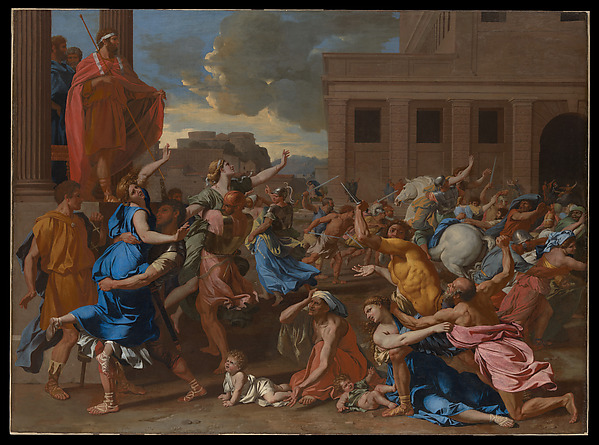
Image title: The Abduction of the Sabine Women
Medium: Oil on canvas
Date: probably 1633–34
Source:
The Met Collection
“
The problem with Google is you have 360 degrees of omnidirectional information on a linear basis, but the algorithms for irony and ambiguity are not there. And those are the algorithms of wisdom.
”
— William Hurt
AI Paints Back: When Algorithms Develop Aesthetic Taste
Introduction: Machines at the Easel
For centuries, art has been the domain of human imagination — a space where intuition, emotion, and lived experience fuse into visual expression. Yet in the 21st century, that space is expanding. Artificial intelligence now paints, sculpts, and designs, blurring the line between codified instruction and creative intuition. As algorithms begin to perceive patterns of beauty, color balance, and style, they inch toward something once thought exclusively human: aesthetic taste. This transformation invites us to reexamine art’s essence — not merely how it is made, but what it means to create.
Chapter 1: From Brushstrokes to Binary — The Historical Roots
To understand AI’s creative rise, we must trace art’s long relationship with technology. The Renaissance’s use of linear perspective, for example, was an algorithmic system before computers — a mathematical framework for depicting depth. Centuries later, the camera democratized image production, forcing painters to redefine the purpose of their craft. The industrial revolution introduced new materials and chemical pigments, reshaping the palette of modernity. Each innovation disrupted traditional notions of authorship and authenticity, setting the stage for today’s digital creators.
The dawn of digital art in the late 20th century marked another pivotal shift. Artists like Harold Cohen, who created the pioneering AI art program AARON in the 1970s, began teaching machines to draw autonomously. Though primitive by modern standards, these early systems posed radical questions: Could creativity be modeled? Could an algorithm have style?
Chapter 2: The Machine as Apprentice — Early AI and Artistic Learning
As computing power grew, so did the complexity of AI art. Through machine learning, algorithms began analyzing vast databases of artwork, identifying patterns in composition, texture, and color. Generative Adversarial Networks (GANs) became the dominant framework, pitting two neural networks against each other — one generating images, the other judging them. This adversarial process mimicked the feedback loop between artist and critic, resulting in art that appeared startlingly human in its sensitivity to aesthetics.
Projects like DeepDream and style transfer technology captured public attention by allowing machines to reinterpret visual styles — Van Gogh’s turbulence or Monet’s soft impressionism — within new images. This wasn’t mere replication; it was the beginning of synthetic interpretation, an algorithmic form of taste development.
Chapter 3: Aesthetics Reprogrammed — The Algorithm Finds Its Voice
Modern AI systems are not only imitating existing aesthetics; they are now generating original visual languages. When programs such as DALL·E, Midjourney, or Stable Diffusion generate imagery, they operate through probabilities — not by copying, but by predicting what ‘feels right’ based on billions of visual examples. The outcome is an emergent intuition: machine-generated beauty that resonates with human emotion without human intervention.
Critically, this introduces a new layer in aesthetic philosophy. If beauty was once in the eye of the beholder, it might now emerge in the feedback loops of data and computation. Curators and programmers become co-authors, guiding but not dictating. The algorithm’s ‘taste’ evolves through the feedback it receives — not unlike the evolution of artistic sensibility across centuries.
Chapter 4: Authorship in the Age of Artificial Imagination
With AI art now commanding attention in galleries and auctions, questions of authorship and ownership take on urgency. Who is the artist — the coder, the algorithm, or the dataset that trained it? Art markets are beginning to adapt, but cultural institutions struggle with attribution. Unlike traditional art, where brushwork or subject can reveal a signature hand, AI art blurs identity into a networked collaboration of human and machine.
This tension recalls earlier moments in art history when creativity became decentralized — from the medieval workshop to the Bauhaus collective. Just as artisans once shared aesthetic labor, we now share creative cognition with our algorithms. Authorship becomes not a solitary act, but a system — a symbiosis of intention and computation.
Chapter 5: The Future Canvas — Intuition Beyond the Human
As we enter an era where AI can refine its aesthetic sense, we confront profound questions: Can machines experience beauty? Or are they only mirroring our preferences back to us? In truth, AI’s growing aesthetic ability is a mirror of humanity’s ambition — the drive to externalize thought, intuition, and taste. Yet it also forces us to define creativity anew. Perhaps art’s essence lies not in emotion alone, but in the act of interpretation — whether by neuron or neural network.
Artists of the future may no longer distinguish between paint and code, inspiration and data. What remains constant is art’s purpose: to explore and express what it means to be conscious. As algorithms paint back, we are not losing our artistic soul — we are expanding it into new, intelligent dimensions of beauty.
In the dialogue between artist and AI, the brush passes both ways. The future of aesthetics will belong not to humans or machines alone, but to the collaborative rhythms that emerge when logic dreams and art learns to calculate.
Useful links: