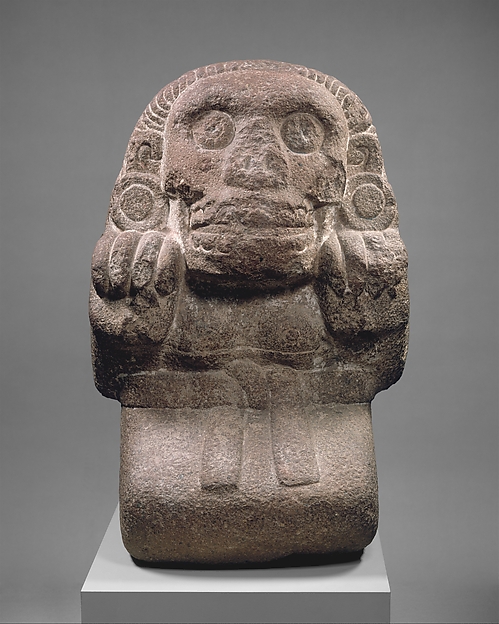
Image title: Cihuateotl
Medium: Volcanic stone (porphyritic andesite), pigment
Date: 15th–early 16th century
Source:
The Met Collection
“
The philosophy of the school room in one generation will be the philosophy of government in the next.
”
— Abraham Lincoln
Mesoamerican Maps of the Soul: Reading Aztec Codices as Visual Philosophy
Introduction: Decoding the Painted Cosmos
Long before the Western world conceived of philosophy as a written discipline, the civilizations of Mesoamerica were encoding systems of thought within pigments, glyphs, and pictorial harmonies. The Aztec codices—folded manuscripts painted on deerskin or amatl bark paper—were not mere records of tribute or ritual; they were visual treatises on existence. Each glyph and figure, once decoded, reveals an entire cosmology of movement, duality, and transformation. To read these codices is to enter a dialogue with a civilization that saw art, religion, and philosophy as inseparable.
In this exploration, we reinterpret pre-Columbian manuscript imagery as a form of visual philosophy—maps of the soul that guide us through the Aztec understanding of the cosmos, time, the divine, and the human place within the great cosmic engine.
Chapter I: Codices as Living Texts of Creation
The creation of Aztec codices was, fundamentally, an act of world-making. The artists—known as tlacuilos—were both painters and scribes, visual philosophers whose brushstrokes carried theological weight. Working with earth pigments and sacred iconography, they crafted images that were not only descriptive but performative: the act of painting was ritual, re-inscribing the universe with every line. Scenes from the Codex Borgia and Codex Fejérváry-Mayer reveal cyclical calendars and divine genealogies. These images are diagrams of existence, where gods, animals, and celestial forces interplay in a dynamic vision of balance. Through color, symmetry, and motion, the tlacuilos rendered invisible energies visible.
Chapter II: The Philosophy of Time and Motion
Unlike linear European chronologies, Aztec time was circular, endlessly regenerating through cycles of creation and destruction. This philosophical stance is most vividly represented in the calendars and cosmograms found in codices such as the Codex Borbonicus. Days are not sequential markers but living entities, each carrying its own essence and divine patron. The glyphs, often arranged as swirling spirals or fourfold axes, visualize the idea that time itself is a living being—one that must be fed, appeased, and harmonized with ritual. The codices transform time into space, making it readable and experiential.
Chapter III: Pictorial Theology and the Human Condition
Aztec visual philosophy placed human existence at the center of a precarious cosmic balance. The vibrant imagery depicting heart offerings, celestial serpents, and agricultural cycles transcends mere narration. These are metaphysical statements about interdependence: the heart becomes the axis that sustains the gods, while the gods ensure the continuation of life. The Codex Mendoza, with its depictions of conquest and tribute, extends this interdependence into social philosophy—every human act has cosmic reverberations. To live ethically, in the Aztec worldview, was to maintain alignment with the greater cosmic order visualized in the painted pages.
Chapter IV: Colonial Intersections and Transformations
With the arrival of Spanish missionaries and chroniclers in the 16th century, the codices underwent a profound metamorphosis. Hybrid manuscripts such as the Codex Florentino show European influence in perspective, script, and Christian iconography, yet retain Indigenous philosophical threads. The dialogue between text and image became a negotiation between two worldviews—the Western linear narrative and the Mesoamerican cyclical cosmology. These colonial codices serve as palimpsests, where visual thought persists beneath the imposed alphabetic order. They bear witness to the resilience of Indigenous philosophy expressed through imagery, even under cultural displacement.
Chapter V: Contemporary Reinterpretations and Digital Rebirth
Today, digital technologies have opened new possibilities for engaging with Aztec codices. Artists, historians, and technologists are using high-resolution imaging and virtual reality to reconstruct damaged manuscripts, revealing pigments and layers invisible to the naked eye. Contemporary Indigenous artists reinterpret codical motifs through digital art, reactivating ancient visual languages as modern expressions of identity. In re-examining these codices as visual philosophies, we rediscover their capacity to speak to universal human questions: What is our relationship to time, to the cosmos, to one another? The codices remind us that art, at its most profound, is not merely representation—it is ontology itself, a painted map of the soul.
Conclusion: Reading the Universe through Image
To truly read an Aztec codex is to practice a form of contemplation. Each glyph invites meditation on balance and transformation. The Mesoamerican mind did not separate seeing from knowing. In their painted knowledge, we find a lesson for our own fragmented age: to remember that art can embody thought, that the image can still be a living philosophy of the universe.
Useful links: