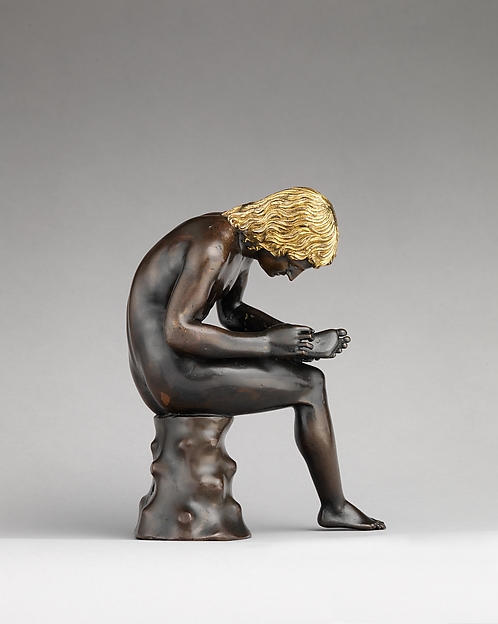
Image title: Spinario (boy pulling a thorn from his foot)
Medium: Bronze, partially gilt (hair) and silvered (eyes)
Date: probably modeled: 1496, cast: ca. 1501
Source:
The Met Collection
“
Good actions give strength to ourselves and inspire good actions in others.
”
— Plato
Bronze Futures: How Ancient Casting Techniques Inspire Contemporary Sculpture
1. The Eternal Allure of Bronze
Few materials have bridged epochs with the grace and endurance of bronze. From the ritual vessels of Shang China to the shimmering athletes of Classical Greece, bronze has embodied permanence, power, and technical brilliance. Its alloyed nature—a blend of copper and tin—gave artists pliability during the casting process and strength afterward. What fascinates contemporary sculptors today is not only the material’s durability but also the poetic continuity it offers: each modern cast, no matter how experimental, is bound to those first hands that poured molten metal into molds thousands of years ago.
In this sense, bronze is more than a medium—it is a time-traveler. It speaks of civilizations that rose and fell, of gods reimagined in metal, and of humanity’s unbroken desire to give tangible form to ideas. Contemporary artists are now rediscovering this lineage, not through nostalgia but through reinvention.
2. Ancient Foundations: The Lost-Wax Legacy
The lost-wax casting technique, known as *cire perdue*, is one of humanity’s earliest and most refined artistic technologies. First emerging in the Bronze Age, it enabled artisans to reproduce intricate forms with astounding detail. The process involves creating a wax model, encasing it in clay or plaster, melting away the wax, and replacing its absence with liquid metal. When cooled and unveiled, what remains is both artifact and miracle: a faithful metallic echo of an ephemeral form.
For ancient societies—from Mesopotamia’s votive figures to Benin’s regal bronzes—the process was not merely technical but spiritual. The transformation of wax to metal symbolized renewal and permanence, a form of material alchemy. This sensibility continues to inform the mindset of modern sculptors who view casting not just as fabrication but as a philosophical act of creation and transfiguration.
3. Industrial Revolutions and Material Shifts
The Industrial Revolution of the nineteenth century drastically altered sculptural practice. Foundries proliferated, allowing for mass production and monumental public bronzes that celebrated empires rather than deities. Auguste Rodin’s studio, for example, worked with skilled artisans who translated his clay models into cast metal—a process that blurred the line between artist and technician.
Yet this era also signaled the start of a more detached relationship with materiality. Mechanized casting diminished the aura of handcrafted uniqueness. For later generations, particularly those confronting modernism, this became a key question: could industrial technique coexist with artistic authenticity? It is precisely this dialectic that contemporary artists revisit when they combine digital modeling methods with ancient lost-wax casting traditions.
4. Digital Bronze: Rebirth through Technology
Today’s sculptors operate in a space where history and technology converge. Artists like Barry X Ball and Kehinde Wiley have explored the intersection between 3D imaging, computer-aided design, and traditional bronze casting. The wax models of the past are now often replaced by 3D-printed resins, yet the ritual of investment, burnout, and pour remains startlingly similar.
This modern adaptation of ancient craftsmanship reflects broader cultural shifts. In an era defined by virtuality, the weight and permanence of bronze offer a reassuring counterbalance. The act of casting, both digitally planned and manually executed, becomes a dialogue between tactile labor and algorithmic precision. Through this convergence, the old technique finds a renewed philosophical dimension: technology does not erase tradition but enables its evolution.
5. Futuristic Alchemies: Bronze as Conceptual Bridge
Contemporary sculptors engaging with ancient casting are not simply invoking antiquity—they are projecting it into the future. Some blend bronze with nontraditional substances such as carbon fiber and titanium dust, hinting at extraterrestrial architectures or post-human anatomies. The results are forms grounded in material heritage yet speculative in vision.
This relationship between the archaic and the futuristic has deep philosophical resonance. Bronze, the first alloy of civilization, becomes a metaphor for synthesis—between past and future, craft and code, permanence and transformation. It demonstrates how art, even when rooted in technique, evolves as an intellectual ecosystem, one that continually redefines what it means to create in a world that venerates both the ancient and the new.
6. Conclusion: The Metal That Remembered
From ancient ritual fires to today’s digital foundries, bronze continues to be a vessel for human imagination. Each casting, whether crafted by a Bronze Age artisan or a contemporary sculptor using 3D printing, embodies the same miraculous process of turning absence into presence, idea into form. The persistence of lost-wax techniques in our technologically driven century reminds us that true innovation often resides not in rejection of the past but in its reinvention.
Bronze’s future, it seems, is not a destination but an ongoing conversation—a molten pathway linking memory to possibility, craftsmanship to creativity, and ancient wisdom to art’s ever-expanding horizon.
Useful links: