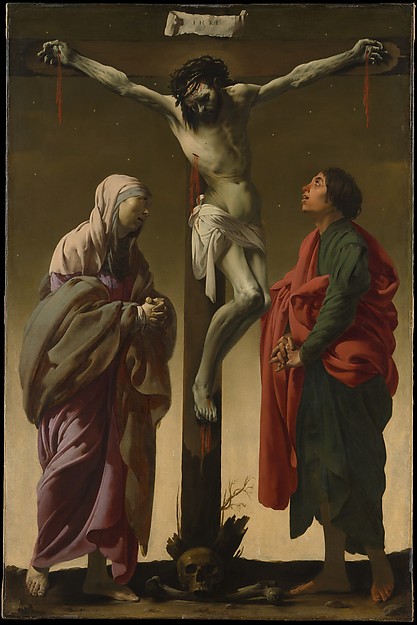
Image title: The Crucifixion with the Virgin and Saint John
Medium: Oil on canvas
Date: ca. 1624–25
Source:
The Met Collection
“
Keep your eyes on the stars and your feet on the ground.
”
— Theodore Roosevelt
Mapping the Stars on Canvas: Celestial Charts as Early Data Visualization
Introduction: Painting the Heavens Before the Telescope
Since humanity first looked to the night sky, we have been mapping, interpreting, and mythologizing the stars. Long before the digital age brought us data visualization software and interactive star charts, early civilizations were already producing remarkably complex celestial maps that blended empirical observation with spiritual and artistic expression. These early visualizations were more than just guides for navigation or tools for predicting eclipses—they were cosmic artworks, where science, myth, and aesthetics converged. In this article, we’ll journey from the clay tablets of Babylon to the illuminated manuscripts of medieval Europe, tracing how visual art evolved to convey the structure of the heavens.
1. Babylonian Beginnings: Stars in Cuneiform
As early as 1200 BCE, Babylonian astronomers were recording star movements on clay tablets using cuneiform script. These were not artistic renderings as we might visualize today, but they were among the first attempts to catalog heavenly bodies systematically. The Mul.Apin tablets, for instance, described the motion of stars and planets across the sky, forecasting seasonal changes and celestial events. Even in this mathematical endeavor, there was an art to how constellations were conceptualized—as metaphors and deities, symbols woven into the Mesopotamian worldview. The sky was visualized as a divine map, and these diagrams served both religious calendar keeping and agricultural planning. The Babylonian contribution laid a scientific foundation that would be inherited, enhanced, and painted onto parchment in later centuries.
2. Hellenistic Innovations: The Fusion of Myth and Measurement
In ancient Greece, the work of Ptolemy and Hipparchus ushered in a more geometric understanding of the cosmos. While Ptolemy’s Almagest was primarily technical, Greek culture infused star maps with mythological depth. Sculptors and painters began depicting the constellations not only as coordinates but as vivid beings—Andromeda, Orion, Pegasus—linking cosmic space with epic narrative. The Greek innovation was to lace empirical measurement with Greek mythology, a duality that reflected their philosophical ideal: harmony between form and function. Even mosaics in the homes of wealthy Romans featured zodiac signs and celestial spheres, signaling the owner’s erudition and cosmic alignment. Here, visual art stepped in as both embellishment and education, laying groundwork for star mapping as a symbolic language.
3. Islamic Golden Age: The Art of Precision
From the 8th to the 15th century, Islamic scholars carried celestial mapping to dazzling new heights. In centers like Baghdad, Samarkand, and Cairo, astronomers such as Al-Sufi and Ulugh Beg meticulously improved upon Greek and Indian charts. Their work wasn’t just mathematical—it was deeply visual. Manuscripts featured inked constellations in the shapes of animals and figures from Islamic astronomy. Remarkably detailed star atlases used gold leaf and vibrant dyes on parchment, echoing both scientific labors and spiritual beauty. The Islamic world pioneered the production of the astrolabe, a visual computational instrument that mapped the stars onto discs, stunning for both their utility and aesthetic symmetry. In this era, celestial visuals became interfaces—tools for navigating the earth, marking prayer times, and understanding one’s place in a divinely ordered cosmos.
4. Medieval and Renaissance Europe: Celestial Scribes and Artistic Alchemy
As Europe emerged from the Middle Ages, celestial cartography took on renewed prominence in illuminated manuscripts and early printed books. Artists worked alongside scholars in places like Bologna and Nuremberg to render complex cosmographies—depictions of the stars, spheres, and divine orders—on vellum and in block prints. The 15th-century Nürnberg Chronicle combined narrative history with celestial diagrams. Later, in the age of Copernicus and Galileo, artists celebrated the shift from geocentric to heliocentric models with stunning visuals. The Jesuit priest Athanasius Kircher produced elaborate star maps laced with theological allegories, blending the new science with old metaphysics. These were among the first “infographics” in the modern sense: explanatory visuals meant to educate, provoke wonder, and align the viewer with new cosmic truths.
5. Toward Modernity: Enlightenment, Romanticism, and the Rise of Data Art
By the 18th and 19th centuries, the mapping of the stars had become even more precise—but also more poetic. Enlightenment thinkers like William Herschel began charting thousands of stars, while Romantic artists like John Martin painted apocalyptic skies where cosmic vastness served as moral metaphor. Star maps from this period—such as the 1833 Leonid meteor shower engravings—combined accurate observation with dramatic artistic flair, illustrating the sublime beauty and terror of the heavens. These images set the stage for 20th-century planetary diagrams, NASA mission illustrations, and even today’s interactive simulations. As modern infographics emerged, drawing from principles developed centuries prior, one can trace their lineage back not only to scientists, but to the painters who first imagined how data could be beautiful.
Conclusion: The Stars as Our Shared Canvas
From Babylon to Bologna, early star maps were acts of cultural synthesis—scientific aids, artistic treasures, and spiritual diagrams all in one. They remind us that visualization is not a cold rendering of data, but a deeply human endeavor: an attempt to impose order, beauty, and meaning on the infinite. Today’s data visualizations—whether in newspapers, planetariums, or mobile apps—owe a profound debt to these celestial artworks. In mapping the sky, our ancestors mapped themselves: their beliefs, dreams, and aspirations, etched not only in stone and ink, but across the medium of time itself.
Useful links: