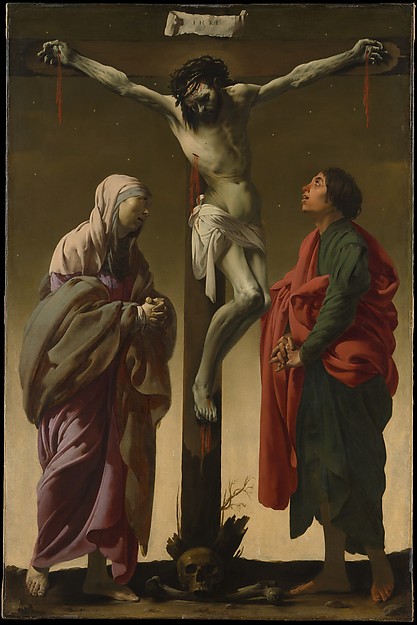
Image title: The Crucifixion with the Virgin and Saint John
Medium: Oil on canvas
Date: ca. 1624–25
Source:
The Met Collection
“
The personal life deeply lived always expands into truths beyond itself.
”
— Anaïs Nin
Beyond the Frame: Hidden Narratives in Mughal Empire Miniature Paintings
Introduction: Manuscripts of Power
At first glance, the elaborately ornamented miniature paintings of the Mughal Empire appear to be courtly embellishments—lavish illustrations serving the aesthetic whims of emperors. Yet behind their jewel-toned hues, intricate brushwork, and gold borders lies a nuanced language of metaphor and rebellion. These paintings are not merely decorative; they are visual manuscripts of power, subversion, and storytelling that reveal the philosophical and political tensions of their time. This blog explores the hidden narratives embedded in Mughal miniatures, surveying their evolution across artistic periods and decoding the rich textures of meaning they conceal and convey.
1. Origins of Influence: Persian Roots and Indigenous Synthesis
The Mughal miniature tradition, which flourished between the 16th and 18th centuries, draws its earliest influences from Persian manuscript painting introduced to India by the Timurid descendants of Babur, the empire’s founder. Early workshops under Humayun and Akbar fused Persian stylistics—flat planes, hieratic scale, and vibrant pigments—with local visual and cultural motifs from Rajput painting and Jain manuscript traditions. The result was a uniquely syncretic form that reflected the multicultural realities of the empire.
These early works, often illustrating epics like the Hamzanama, weren’t just mythological entertainment. Their allegorical content often mirrored contemporary political ideologies. The choice of narratives—fatally flawed heroes, treacherous allies, divine interventions—allowed safe critique of court politics under the guise of mythology. Akbar’s own endorsement of illustrated storytelling signaled art’s transition from private luxury to imperial ideology.
2. Akbar’s Vision: The Political Canvas
Under Emperor Akbar (r. 1556–1605), the Mughal atelier expanded not only in size but in ambition. Akbar saw art as essential to the architecture of empire—where visual splendor underscored divine rule. His court historians, Abul Fazl and others, were tasked with chronicling empire through both text and image. Illustrated volumes like the Akbarnama and Baburnama gave rise to political art that narrated not only past conquests but also justified current rule through visual parallels to historic greatness.
But embedded between the depictions of majestic processions and celestial symbols were subtle critiques and alternative readings. Figures in secondary roles are sometimes rendered with exaggerated expressions or postures that hint at dissent or satire. The physical layering of images—the way one figure’s gaze interacts with another’s movement—often suggests a hidden choreography of power and interpersonal tension. Artists like Basawan gained recognition for their psychological realism, which added layers of empathy and subversion to imperial iconography.
3. Jahangir’s Era: Allegory and Aestheticism
Jahangir’s reign (r. 1605–1627) witnessed the golden age of Mughal miniature painting. A passionate aesthete, Jahangir encouraged naturalistic detail and European influences, especially Christian iconography and Renaissance spatial perspectives, absorbed through diplomatic exchanges with Jesuit missionaries. The result was a visual hybridity that accommodated layered symbolism.
One striking example is Bichitr’s famous “Jahangir Preferring a Sufi to Kings,” in which the emperor hands a book to a mystic while declining interaction with King James I of England and the Ottoman Sultan. This painting operates as a visual manifesto. It extols Sufi spirituality over political diplomacy, subtly criticizing temporal rulers. The image constructs empire as moral hierarchy rather than geopolitical might. Beneath its sumptuous surface lies argumentation through allegory—affirming the values of syncretism, moral virtue, and self-legitimization.
4. Aurangzeb and the Austerity Turn: Decline or Reinterpretation?
With Aurangzeb’s ascension (r. 1658–1707), Mughal patronage shifted dramatically due to his orthodox Islamic values. He reduced expenditure on figurative painting, reorienting the court away from visual opulence toward calligraphy and architectural patronage. It would be tempting to describe this as decline—but the artistic field responded with evolution.
Artists, now detached from imperial workshops, turned toward regional courts in Rajasthan, the Deccan, and Punjab. There, freed from rigid court protocols, miniature painting found new lifeblood. The themes shifted—less about grandeur, more about intimacy. Lovers meeting in gardens, poets contemplating under moonlight, or holy men in rustic solitude became new centers of emotional gravity. Yet even here, subversion lingered. The act of reusing imperial iconography in regional contexts subtly challenged the Mughal center and its spiritual divergence.
5. Legacy and Digital Resurrection: Miniatures in the Age of AI
Today, Mughal miniatures are undergoing a digital renaissance. High-resolution photography, AI-assisted image analysis, and museum digitization projects have brought these artworks from royal vaults to global accessibility. Scholars are applying machine learning to recognize stylistic patterns, track workshop collaborations, and even hypothesize narratives lost to time.
Artists, too, are returning to this form with postmodern intent. Contemporary Indian and Pakistani painters like Shahzia Sikander interrogate and remix Mughal visual codes to speak on gender, identity, and colonialism. Their work inhabits a cybernetic mirror realm where the old symbols resurface, charged with new urgency. In these reinterpretations, the miniature becomes maximal—its tiny surface opening vast spaces for political debate, historical reparation, and aesthetic rejuvenation.
Conclusion: Reading the Margins
To understand Mughal miniature painting is to read beyond decoration—to grasp the scroll not as a static artifact, but as part of a living manuscript of power, culture, and resistance. These works, often held within the chiaroscuro of empire, reveal their brilliance fully only when read with attention to their subtexts, absences, and ironic juxtapositions. The brush was not immunized from politics—it wrote politics, veiled and vivid, page by gilded page. In the miniature’s margin lies magnitude.
Useful links: